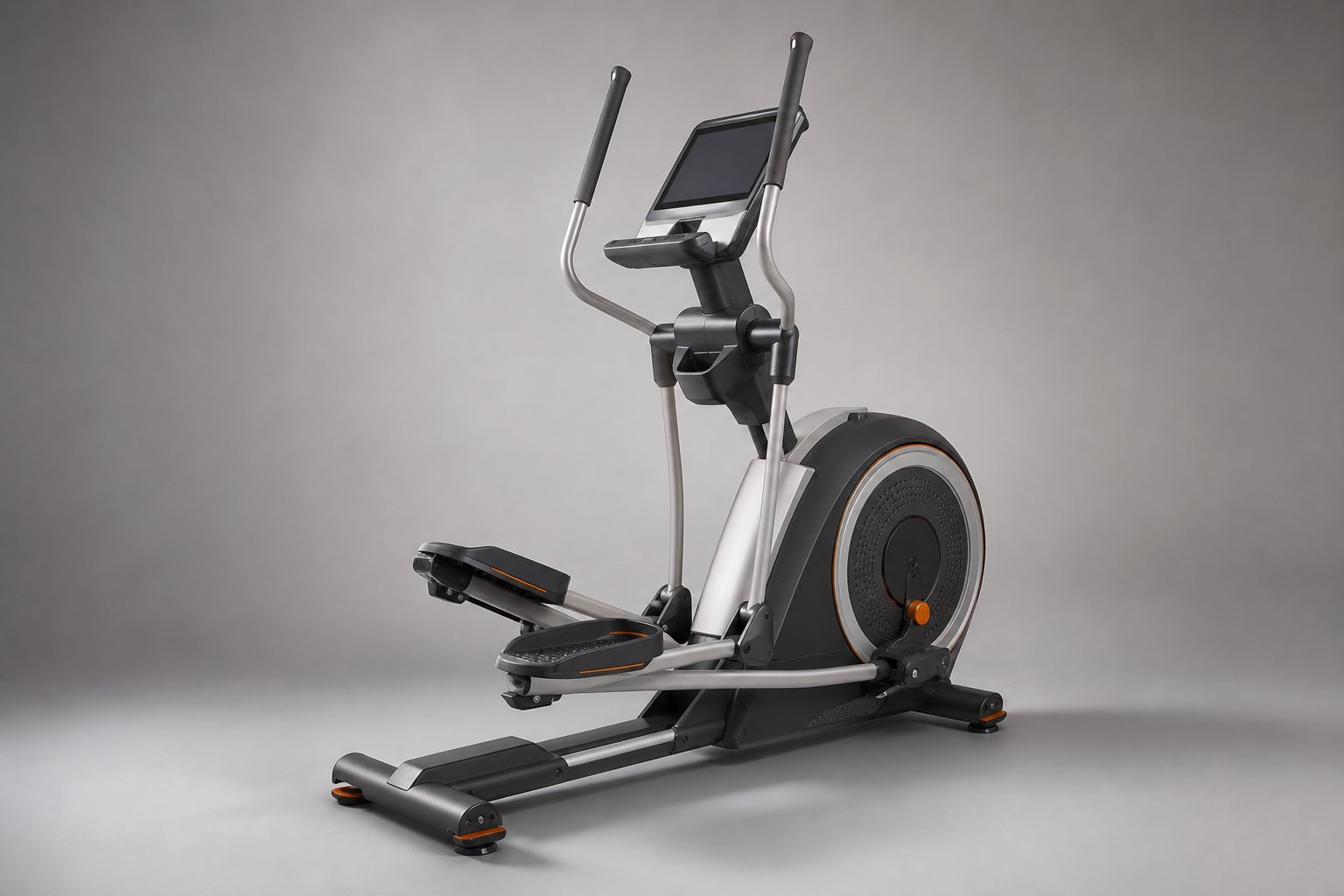
Ellipticals are the low-impact gateway of every cardio line — the machine recommended to buyers whose knees disqualify the treadmill, and the one most often purchased for shared households where users differ in height, fitness and ambition. They are also the cardio category with the murkiest spec language: flywheel figures quoted without units, stride lengths confused with frame length, resistance levels counted differently by every brand. That murkiness is an opportunity for sellers who publish clean specifications, because the elliptical buyer is comparison-shopping harder than the treadmill buyer and rewards the listing that answers the three questions that matter: how smooth, how long the stride, how fine the resistance. This guide decodes each spec in turn, maps them to user heights and placements, and ends with the checklist that keeps your elliptical reviews about the workout instead of the wobble.
Flywheel: what the mass actually does
The flywheel is the elliptical's personality. Its mass determines inertia — how much the rotating system resists starting, stopping and uneven pedaling — which the user experiences as smoothness: a heavier flywheel carries the pedal stroke through dead spots and keeps low-cadence work fluid, while a light flywheel at a hard resistance level feels choppier and can pulse with each stride. Quoted figures deserve the same scrutiny as treadmill horsepower: ask for flywheel mass in kilograms and the drive system next to it. Rear-drive designs place the flywheel behind the user, giving a longer footprint with a classic flat ellipse; front-drive designs fold the mechanics forward into a shorter footprint, which is why they dominate apartment-sized models. Neither placement is superior — the stride path and the housing geometry decide the feel — but the mass should be stated honestly, because it is the single best predictor of whether a budget elliptical feels stable or sketchy under a real adult.
Stride length: the fit spec that decides comfort
Stride length is the distance the pedal travels in one full elliptical path, and it is the closest thing this category has to a clothing size. Our range spans 34 to 51 cm. At the short end, 34 to 40 cm strides fit smaller users and tighter budgets: the motion is compact, the frame is shorter, and users up to roughly 170 cm feel natural on it — but a tall user on a short stride looks and feels like they are riding a scooter. Mid-range strides around 41 to 45 cm cover family use, where several people of different heights share one machine. At the long end, 46 to 51 cm delivers the flat, running-like gait taller users need for a natural heel-toe motion. For a catalog, the practical mapping is: 34 to 40 cm as the entry home SKU, 41 to 45 cm as the family default, 46 to 51 cm as the premium and light-commercial option. Publish the stride figure prominently — it is the number buyers most often fail to check and most often return machines over.
Resistance levels: why magnetic wins the category
Elliptical resistance in our lines is magnetic — a magnet moved closer to or farther from the flywheel — which is why the category can promise near-silent operation and zero contact wear. The ladder depth is the spec to compare. Eight to ten levels cover entry-home use: enough range for a beginner to grow into and a fitter user to sweat. Sixteen levels, the top of our home range, give the granularity demanding users want for interval programming, and they are the sensible floor for light-commercial placement where multiple users of different fitness levels share the machine. Programmability rides on the ladder: consoles that store user profiles and interval patterns multiply the value of fine resistance steps. And because magnetic resistance generates no friction parts, the maintenance story is the category's quiet selling point — no belt dust, no pads to replace, just the occasional rail wipe, which is precisely the sentence that appears in five-star reviews written six months after purchase.
| Spec | Entry home | Family / pro home | Light commercial |
|---|---|---|---|
| Flywheel | Lighter mass, stated in kg | Mid mass, stated in kg | Heavier mass, stated in kg |
| Stride | 34–40 cm | 41–45 cm (46–51 cm for tall users) | 46–51 cm |
| Resistance | Magnetic, 8–10 levels | Magnetic, up to 16 levels | Magnetic, 16 levels, high duty |
| Noise | Quiet, stated dB where tested | Quiet, stated dB | Quiet under continuous use |
| Rated user weight | Declared per model | Declared per model | Declared, higher duty cycle |
| Usage class | Class H per EN ISO 20957-9 | Class H per EN ISO 20957-9 | Class S per EN ISO 20957-9 |
Match the spec to the buyer, then say it out loud
Three buyer profiles cover most elliptical demand. The knee-conscious buyer is buying impact reduction first: any level of the range serves them, and the listing should say the word low-impact early because it is the reason they arrived. The family buyer is buying a fit compromise: point them at the 41 to 45 cm stride with sixteen levels, and the machine survives teenagers, parents and grandparents. The apartment buyer is buying quiet: magnetic operation plus a stated noise figure is the whole pitch, and footprint comes second — which is where front-drive designs earn their place. For studios and physio-adjacent placements, Class S hardware under EN ISO 20957-9 with the heavier flywheel and full sixteen-level ladder is the correct answer, and it should be quoted as such rather than as an upgraded home unit. Each profile reads the same spec sheet differently; the seller's job is to translate the sheet into each buyer's first sentence.
The pre-order checklist
Five lines, one email. One: flywheel mass in kilograms and drive placement, rear or front. Two: stride length in centimeters — not frame length, stride — with the height range it serves. Three: resistance type and level count, eight to sixteen in our range, with console programming capabilities. Four: measured noise and rated user weight, stated per model. Five: usage class under EN ISO 20957-9 and the packing spec — ellipticals ship as multi-carton sets with labeled hardware, and a drop-tested export pack is what keeps the first impression a good one. Suppliers who answer these five precisely will produce ellipticals that match their quotations; suppliers who blur the stride or the flywheel figure are outsourcing the disappointment to your review page.
Conclusion
An elliptical is smoothness, stride and granularity — flywheel mass in kilograms, stride length in centimeters, magnetic resistance in levels, all wrapped in a machine whose silence is its own sales pitch. Publish those four numbers with the usage class and your listing becomes the honest one in a category where most competitors hide behind adjectives. That honesty compounds: the knee-conscious buyer, the family and the apartment dweller all leave reviews about comfort and quiet, and those reviews sell the next unit without ad spend. Send us your market's height profile and price band, and we will quote the elliptical ladder — entry, family and light-commercial — with full spec sheets attached.
Frequently asked questions
What stride length does a buyer need? Match stride to height: 34 to 40 cm suits users up to about 170 cm, 41 to 45 cm covers family use, and 46 to 51 cm gives taller users a natural, running-like gait. When one machine serves several heights, choose the middle band.
Does flywheel weight really matter on an elliptical? Yes — it is the best single predictor of smoothness. Heavier flywheels keep the stroke fluid at low cadence and hard resistance; light flywheels feel choppier. Ask for the mass in kilograms rather than trusting unnumbered claims.
Are 8 resistance levels enough? For an entry-home buyer, yes: 8 to 10 magnetic levels cover a beginner's progression. Demanding users and shared or light-commercial machines should step up to 16 levels for interval granularity.
Which standard applies to ellipticals? EN ISO 20957-9 is the elliptical part of the stationary-training-equipment framework, with Class S for commercial placements and Class H for home use. State the class on the spec sheet — it is the first question commercial buyers ask.