Ask a room of fitness e-commerce sellers which category drives the cheapest traffic to their store, and resistance bands come up every time: light to ship, cheap to sample, easy to bundle, and bought by almost every home-training customer. Yet the one decision that shapes a band listing most — natural latex or thermoplastic elastomer, usually shortened to TPE — is routinely treated as an afterthought. It should not be. The material determines how the band snaps under load, how it can be positioned for sensitive skin, what it costs per unit and how it survives the first hundred workouts your customers put it through. We run both material lines at FITORIGIN: a color-coded latex loop set graded from 5 to 175 lb, tube resistance bands sold with door-anchor kits, and fabric alternatives for the glute-training niche. This article compares latex and TPE on the parameters that actually decide listings, and closes with a clear stocking recommendation per channel.
Why latex is still the performance benchmark
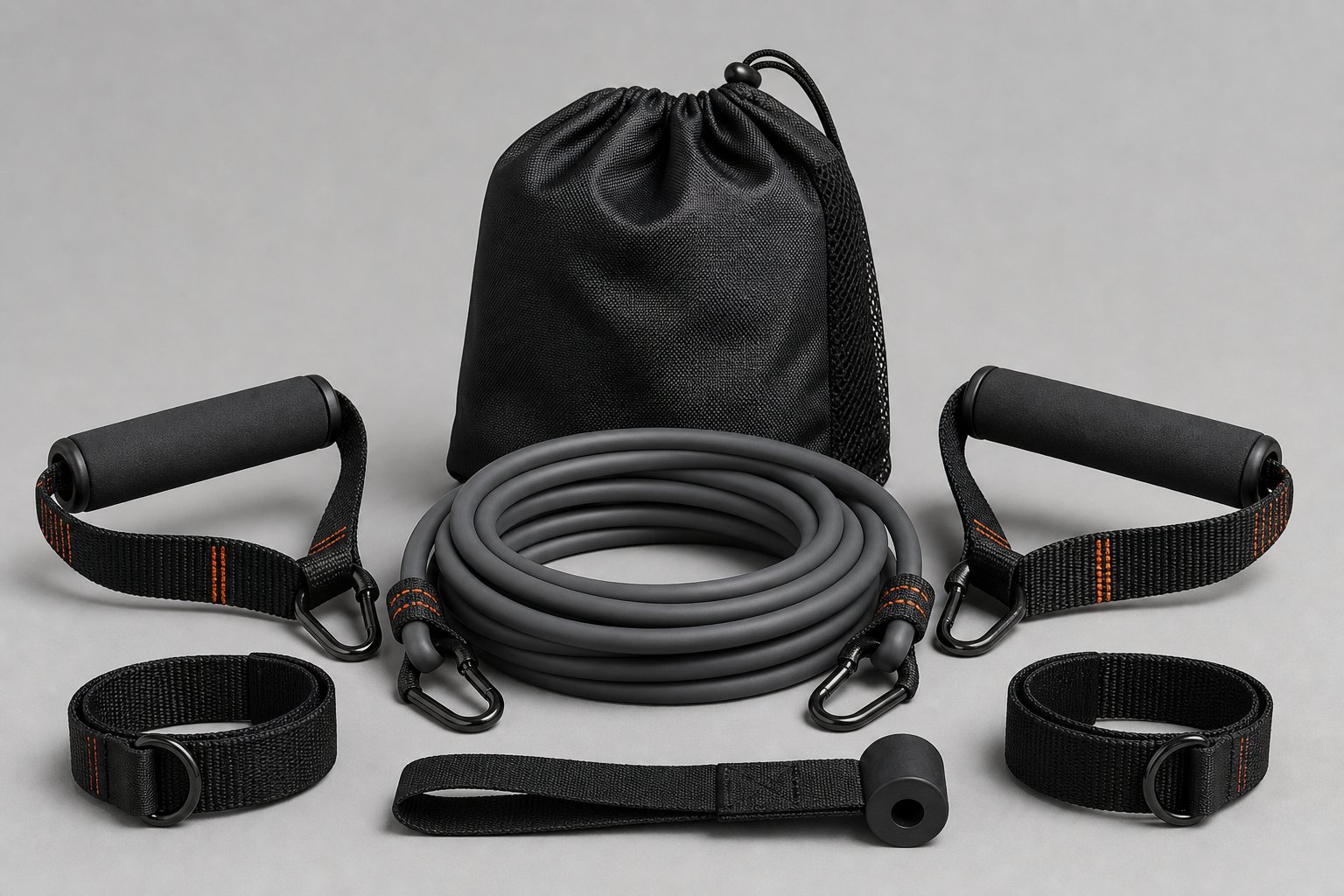
Natural rubber latex has dominated serious training bands for decades for one reason: elastic behavior. Latex stores and returns energy efficiently, so the pull feels alive and the resistance climbs progressively as the band stretches. That progressive curve is exactly what intermediate and advanced users are buying — they want a band that is light at the bottom of a movement and heavy at the top, whether the movement is a pull-up assist, a banded squat or an assisted stretch. Our latex line reflects this positioning: five loop bands with color-coded resistance levels from 5 to 175 lb, so a buyer can progress through the set instead of outgrowing a single band, and tube bands paired with a door anchor to cover presses, rows and face pulls in one kit.
The honest caveat is that not every latex band deserves the performance label. Latex compounds vary widely between factories, and the failure mode is invisible on day one: a band can feel excellent at unboxing and lose tension over weeks of use. That is why our supplier discipline for the resistance-band line is built around rebound decay — bands are put through repeated stretch-and-release cycling and tension retention is checked against the batch standard, rather than judged by a single pull in a showroom. When you qualify a band supplier, ask exactly how they test rebound decay, how many cycles a band must survive, and what tension-loss percentage retires a batch. A supplier who cannot answer has not tested; a band whose tension fades early is the review-section story that no discount can repair.
Where TPE wins, and what it trades away
TPE — a thermoplastic elastomer rather than natural rubber — wins three arguments on its own. First, it is latex-free by formulation: for customers who avoid natural rubber latex, a TPE band removes the objection entirely from the listing, which is why allergy-aware positioning almost always means TPE. Second, skin feel: TPE bands are typically smooth, low-odor and comfortable against skin and clothing, which matters for mini bands worn on bare thighs during glute work. Third, unit cost: TPE is generally cheaper to produce, which makes it the sensible material for entry price tiers where the listing has to survive a price comparison table.
The trade-offs are just as real. TPE does not match latex snap; the pull feels softer and somewhat less progressive, and experienced users notice the difference in dynamic movements. TPE also deserves the same rebound-decay scrutiny as latex — a soft-feeling band that turns slack quickly is still a returns problem. Our guidance is to position TPE honestly rather than to apologize for it: sell it as the latex-free, beginner-friendly, budget-clean option for mobility work, warm-ups and general fitness, and reserve latex for the performance tier where buyers pay for elastic character. Position the two materials against different buyers and they stop competing with each other in your own catalog.
Side by side: the parameters that decide the listing
The comparison below condenses the decision into the row a seller actually argues about when building a band program:
| Parameter | Latex loop bands | TPE bands | Tube bands + door anchor |
|---|---|---|---|
| Elastic feel | Strong snap, progressive tension — the performance benchmark | Softer, less progressive pull; suits mobility and beginners | Consistent draw through a sleeved tube; guided movements |
| Allergy positioning | Natural rubber latex — declare the material plainly | Latex-free; the allergy-aware listing | Varies by tube material — declare per SKU |
| Typical tier | Mid to performance tier; set-based pricing (5-band, 5-175 lb) | Entry to mid tier; single-band and starter kits | Kit-based pricing (handles, ankle straps, door anchor) |
| Skin feel and odor | Rubber character; compounding quality decides odor | Smooth, low-odor, comfortable on bare skin | Handles dominate feel; sleeve protects the tube |
| Durability focus | Rebound decay under repeated cycling; edge tears | Rebound decay; surface wear at anchor points | Carabiner and anchor wear; handle stitching |
| Best-fit channel | Strength and CrossTraining audiences, studio add-on sales | Mass-market home fitness, physio-adjacent gentle training | Home-gym kits, bundled offers, gift season |
One structural note: tube bands sell as kits. Handles, ankle straps and a door anchor turn a low-ticket tube into a complete home solution, and kits raise average order value far better than single bands. That is why our category page lists the tube band explicitly as a door-anchor set — the accessory bundle is the product.
Compliance and the tests to demand
Material compliance belongs in the specification, not in the marketing copy. For soft polymer goods sold into Europe, the phthalate ceiling of 0.1 percent under REACH Annex XVII is the discipline we already apply to yoga mats and foam products, and we hold the band lines to the same bar with material declarations per batch. Beyond compliance, three checks separate a defensible band program from a gamble:
- Rebound decay cycling: tension retention measured after repeated stretch cycles against a written batch standard, not a first-pull demonstration.
- Set verification: for color-coded sets, every band in the five-level 5-175 lb set checked against its declared level — a mislabeled band is a silent returns generator.
- Hardware audit for tube kits: carabiners, door anchors and handle stitching inspected per batch, because kit failures cluster in the hardware, not the tube.
Batch-by-batch inspection records are the minimum evidence. If a supplier offers only a golden sample and a price sheet, the price is telling you what the QC is worth.
Matching material to channel
For dropshipping and parcel channels, bands are about as friendly as fitness products get: light, small, unbreakable in transit and simple to blind-ship in neutral packaging with no supplier information. Our dropshipping program runs these SKUs through parcel lines with ERP integration for Shopify, WooCommerce and Amazon, and a specialist responding within 24 hours — the operational frame matters as much as the product when a category moves at this volume. For private-label programs, the commercial frame is indicative and identical across the band lines: stocked labeled goods from 100 units, light customization (colors, packaging, resistance-set composition) from 500 units, sampling in 7-12 days and production in 20-35 days, with in-stock labeled goods dispatched within 48 hours of payment — all to be confirmed in a formal quotation before you commit listings.
As for assortment: lead the performance audience with the latex five-band color set, cover the entry and allergy-aware search traffic with a TPE line, and keep a tube-band door-anchor kit as the bundle builder. If you want the niche angle, fabric mini bands address the glute-training crowd with a no-roll, no-slip story — a different material conversation entirely, and worth its own listing rather than a footnote.
Conclusion
Latex versus TPE is not a winner-takes-all comparison; it is a segmentation decision. Latex owns the performance tier on snap and progressive tension, and earns that position only when rebound decay is tested batch by batch. TPE owns the entry tier and the latex-free listing on cost, comfort and formulation. Tube kits turn either conversation into a higher-ticket bundle. Decide which buyer each listing serves, demand the decay data before you order, and put the material declaration on the page where regulators and customers can both read it. Send us your channel and price tier, and we will return a matched material mix with indicative quotes — as a source supply chain partner inside China's fitness equipment clusters, we would rather structure the assortment than sell you a single band and hope.
Frequently asked questions
Are TPE resistance bands as good as latex bands? They are different tools. Latex offers stronger snap and a more progressive tension curve, which performance users notice. TPE is latex-free, typically smoother and lower-odor, and cheaper per unit. Choose by buyer: performance strength work leans latex; entry-level, allergy-aware and gentle-training listings lean TPE.
Can customers with natural rubber latex sensitivity use TPE bands? TPE is a thermoplastic elastomer, not natural rubber latex, so latex-free positioning is legitimate. Still request a material declaration per batch and keep the claim on the listing page accurate and specific, rather than making broader health statements.
How do I check band quality before listing? Demand rebound-decay cycling data with a written tension-retention standard, verify every band in a color-coded set against its declared level, audit hardware on tube kits, and ask for batch inspection records plus phthalate documentation under the 0.1 percent REACH Annex XVII ceiling.
What order quantities apply to private-label band programs? On our indicative frame: stocked labeled goods from 100 units, light customization such as colors or set composition from 500 units, sampling in 7-12 days and production in 20-35 days, with 48-hour dispatch on in-stock labeled orders. Final terms belong in a formal quotation.