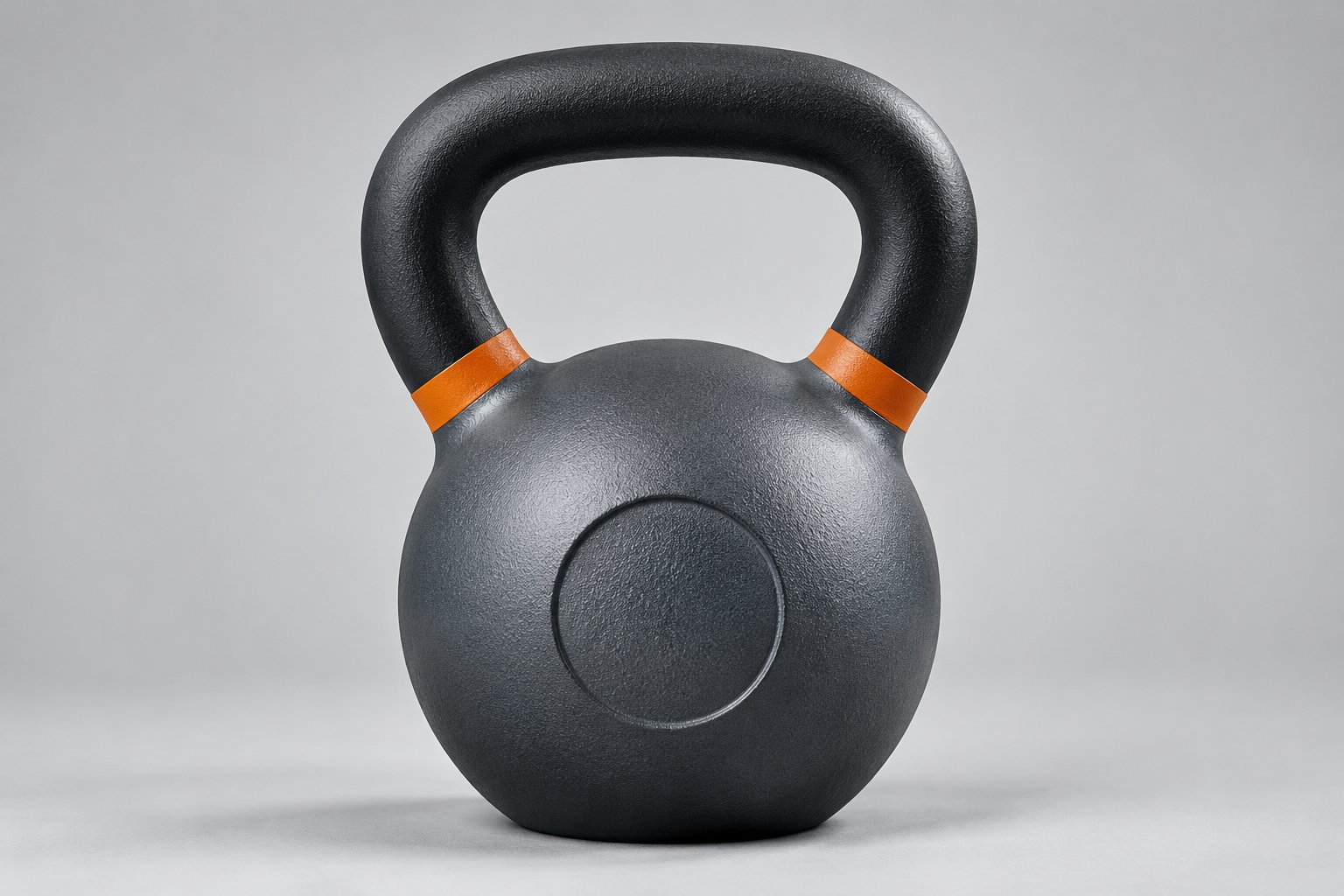
Kettlebells look like the least complicated product in free weights — a ball and a handle — yet the category splits into two engineering standards that sell to different buyers, and stocking the wrong one for your channel is a quiet conversion killer. Competition kettlebells hold their dimensions constant across the entire weight range: a 16 kg and a 28 kg bell are the same size, the same handle, the same feel, because the sport they were built for demands it. Classic cast-iron kettlebells grow with the load: heavier means bigger, with a thicker handle, because they evolved from farm and military iron rather than from sport. Our free-weights category carries both — competition and classic — and the sourcing differences run deeper than paint: casting method, handle finish and weight tolerance all move between the two standards. This article compares them across sizing, material, finish and use cases, then closes with the QC points and logistics reality that decide whether kettlebells are a clean SKU or a freight headache.
Two standards, two buyers
The fastest way to choose is to identify who is holding the bell. A coached athlete doing repeated snatch and clean-and-jerk sets wants the bell to feel identical as the weight climbs — grip geometry, ball size and wrist contact stay constant, so technique transfers across the ladder. That buyer definitionally wants a competition bell. A home user swinging and goblet-squatting twice a week cares about value per kilogram and a handle that fits the hand; the changing silhouette of a classic bell is a non-issue, and its lower price point converts better in a home catalog. Studios, CrossFit-style boxes and kettlebell-sport coaches skew competition; garage gyms, general-strength home users and budget tiers skew classic. Both buyers exist in every market, which is why our own category carries the pair as separate lines rather than forcing one standard on all channels.
Competition bells: one size at every weight
The defining property of a competition kettlebell is dimensional consistency: whatever the number on the body, the ball diameter, handle thickness and height are held to a common specification, with weight achieved through wall thickness. Bodies are steel — cast or fabricated — and competition grades use a single cast steel body with a smooth shot-blasted handle texture designed for long, chalky sets. Two consequences for sellers. First, technique-focused marketing writes itself: the buyer can progress from a light to a heavy bell with zero re-learning, which is a genuine, verifiable product claim. Second, inspection differs from iron: wall-thickness consistency and surface quality around the casting seam matter, because a heavy wall-thickness deviation shows up as both weight error and balance error. For studios that bill by the class, durability is the purchasing argument — a steel body with a quality coating survives years of daily drops onto rubber flooring.
Classic bells: cast iron that grows with the load
Classic kettlebells are the traditional form: a cast-iron body — typically a ductile (CMG) iron casting for strength and drop resistance — whose size and handle thickness increase with weight. That geometry is not a flaw; it is a price-performance feature. Less material at light weights means lower cost per unit at exactly the weights home buyers purchase first, and the thicker handles at heavier weights suit two-handed swings. Finishes divide into two families: raw cast iron with a clear coat or paint, which has texture but can mark floors and hands, and powder-coated bodies with slightly textured handles, which are cleaner indoors and friendlier to chalk. Our sourcing guidance: for home catalogs, powder coat wins on reviews — paint chips are among the most photographed defects in this category, so specify coating adhesion at sampling and check first-article finish before mass production.
| Attribute | Competition kettlebell | Classic kettlebell |
|---|---|---|
| Body material | Steel, single cast body | Ductile (CMG) cast iron |
| Sizing logic | Identical dimensions across all weights; weight via wall thickness | Size and handle thickness grow with weight |
| Handle | Consistent diameter, smooth shot-blasted texture | Thicker as weight climbs; textured or powder-coated |
| Finish notes | Color-coded by weight in most ranges (vendor-specific) | Paint, clear coat or powder coat; chips are the top complaint |
| Best for | Technique work, studios, kettlebell sport, coached groups | Home strength, garage gyms, budget tiers |
| Cost per kg | Higher | Lower |
Handle finish and grip: where returns are decided
Grip is the whole interface between buyer and bell, and finish quality is the first thing a reviewer's thumb finds. Shot blasting leaves a uniform micro-texture that holds chalk without shredding skin — the reason it is the default on competition bells and a finish worth requesting on classic lines too. Powder coat sits between raw and polished: grippy when chalked, easy to wipe down, and far more chip-resistant than wet paint. Raw painted iron is the cheapest route and the one that generates the most finish complaints — flakes at the handle, rust bloom in humid garages. Whatever the finish, edges matter: the handle-to-body transition (the "horn") must be smooth, because a sharp interior edge converts every high-rep set into a complaint. Ask for finish photos of first articles and run a hand check at sample stage; it costs nothing and pre-empts the most common negative review in the category.
Weight ladder strategy and QC
Kettlebells sell as singles and as ladders, and the ladder you stock should match your channel's training culture. A common home-friendly ladder steps in fours — as an example structure (indicative): 8, 12, 16, 20, 24 kg — letting a household cover swings, goblet squats and presses with three or four bells rather than a full rack; studio orders step tighter and buy deeper into the heavy end. Either way, weight accuracy is a promise: our free-weights lines run weight-error sampling inspection on every batch, and kettlebells — dense single-body castings — are exactly where a loose foundry shows. Ask your supplier what tolerance the casting holds, whether bells are weighed per batch, and how balance is checked; a bell that is out of weight is usually out of balance too, and users feel both.
Logistics: a dense parcel with a simple shape
A kettlebell is the friendliest heavy iron to pack and the least friendly to under-pack: one dense body, no protruding mechanisms, but every newton of it concentrated on the carton floor. Carriers draw the usual lines — USPS caps parcels at 70 lb (about 31.8 kg), UPS and FedEx at 150 lb, with handling surcharges from roughly 50 lb (about 22.7 kg), per eFulfillment Service's July 2025 review — so lighter bells parcel well and the heavy end consolidates into LTL or pallet shipments. Packaging that matters here is humble: double-wall corrugated, a molded or corrugated insert that keeps the ball off the box wall, and a carton that survives a drop with the bell resting on its insert, not its corner. Bundle logic is natural — a bell plus a mat plus a band is a coherent starter kit that lifts AOV without changing the freight class.
Conclusion
Choose by buyer, not by fashion: competition bells for anyone who trains kettlebells as a skill and pays for coaching; classic bells for everyone who wants honest iron at a home-friendly price. Inspect the things thumbs and scales actually find — handle finish, horn smoothness, batch weight tolerance — and pack for the drop test, not the shelf photo. Tell us your channel and the ladder you have in mind, and we will return competition and classic options with finish specs, batch inspection terms and indicative quotes from inside the casting cluster.
Frequently asked questions
What is the real difference between competition and classic kettlebells? Sizing and material. Competition bells hold identical dimensions across all weights with weight achieved through wall thickness, in steel; classic bells are cast iron whose size and handle thickness grow with the weight. Technique-focused buyers want the former, value-focused home buyers the latter.
Why do competition kettlebells cost more per kilogram? Precision: holding one size across the range requires consistent wall thickness and finish quality in a steel body, plus color coding by weight. Classic cast-iron bells are cheaper to cast and finish, which is why they win budget and home tiers.
Which finish should home-channel kettlebells use? Powder coat is the safest default: grippy with chalk, easy to clean and far more chip-resistant than wet paint. Specify coating adhesion at sampling — chipped paint is the most photographed kettlebell defect.
How is kettlebell weight accuracy controlled? Through per-batch weight-error sampling inspection at the foundry and before packing, with balance checks on the same samples. A bell outside weight tolerance is usually out of balance as well, and buyers feel both.