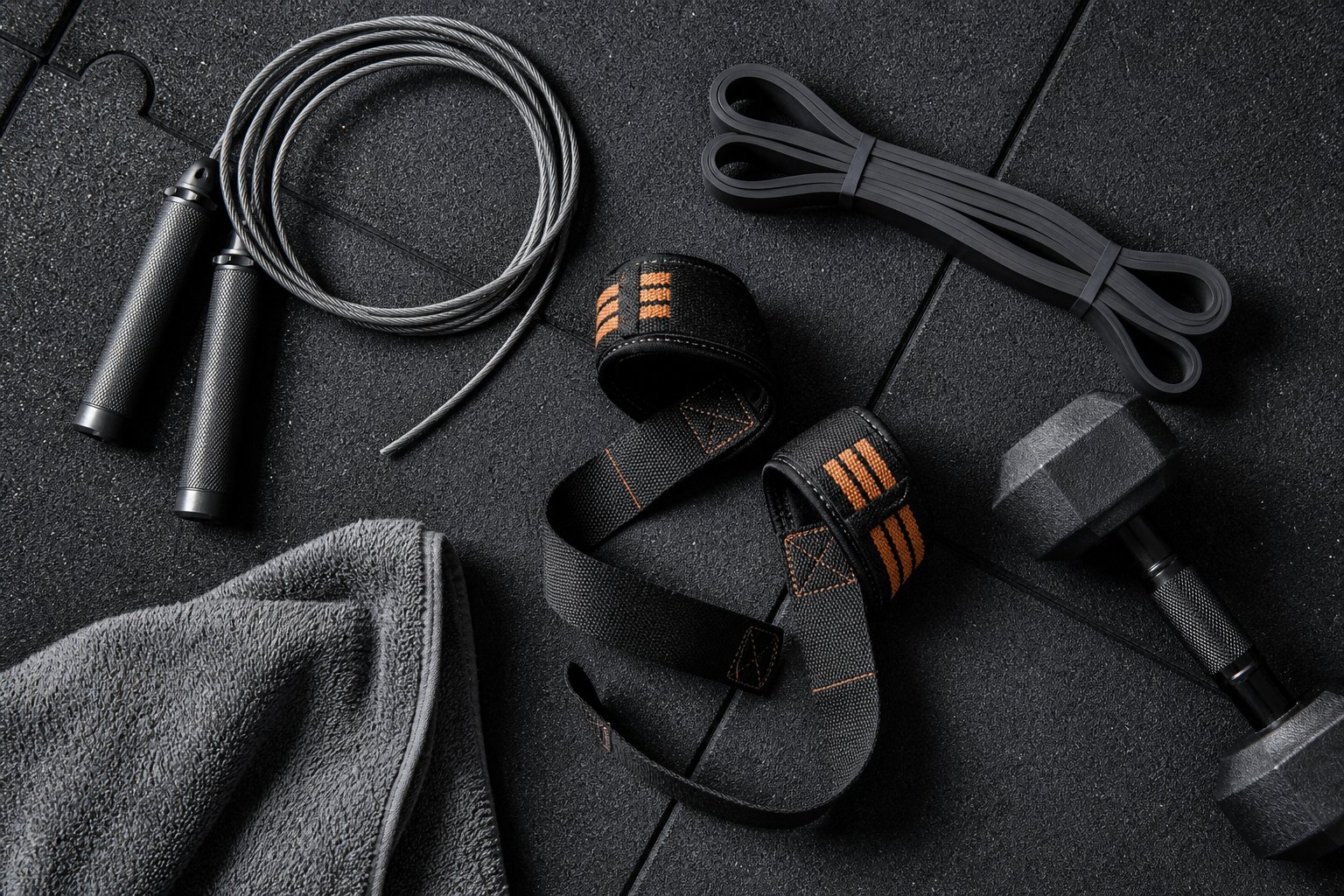
Cardio wins the clicks; strength wins the business. The pattern holds across every channel we supply: racks, benches and free weights convert fewer casual browsers than treadmills do, yet they decide which stores buyers trust, which orders carry real ticket values, and which catalogs earn a second purchase instead of a one-time accessory sale. The demand data backs the anchor logic — a record institutional base of 81 million US gym members, 71.6 million members across Europe, and a global equipment market still growing at 3.9 percent a year — while the supply side concentrates exactly where strength is hardest to fake: Ningjin county builds 70 percent of China's commercial fitness equipment, and Pizhou's strength-line heritage runs back to 1989. This article makes the anchor case with the numbers available, explains why strength goods carry trust and ticket, shows how the category is sourced at quality, and gives a concrete ladder for building strength into a catalog without breaking cash flow. If your store sells fitness and does not sell strength, you are renting your customers from whoever does.
What the demand data actually says
The cleanest way to read strength demand is through the facilities and households that consume it. On the institutional side, the base is at records: 81.0 million Americans held health club memberships in 2025, up 5.2 percent and covering 24.9 percent of the population aged six and over, per the Health & Fitness Association; Europe counted 71.6 million members generating 36 billion euros across 64,550 clubs in 2024, per EuropeActive and Deloitte. Gyms are, overwhelmingly, strength floors — every one of those facilities fills its square meters with racks, benches, stations and free weights, and replaces them on duty cycles.
On the market side, Grand View Research's 2026 edition sizes the global fitness equipment market at 19.7 billion dollars in 2025, rising to 27.4 billion by 2033 at a 3.9 percent CAGR. The firm reports cardio machines as the largest product segment at 55.2 percent of 2025 revenue and describes strength training equipment as a significantly growing segment within the forecast window, without publishing a standalone figure. Treat that honestly: strength has no public market number of its own in the mainstream reports — but the facility numbers above, plus North America's 35.3 percent share of global revenue and the home-use segment's 51.1 percent, say the anchor category is demand-backed from both directions.
The anchor logic: trust and ticket
Why do serious stores insist on carrying strength even when cardio outsells it? Two reasons, one psychological and one arithmetic.
The psychological reason is that strength is the hardest category to fake. A treadmill's quality shows up over months; a rack's shows up in the first heavy session — in the steel, the welds, the hole alignment, the tolerance of a plate bore. Buyers who train know this, and they use a store's strength section as its credibility test. Our benchmark scans keep finding the same gap from the other side: of sixteen comparable fitness store sites we surveyed, none carried large strength equipment — which is why the ones that do stand apart. Carrying real strength goods tells the market you have a real supply chain.
The arithmetic reason is ticket size and attachment. A rack-and-bench order dwarfs a mat order, and every strength anchor drags its constellation: plates in 50 mm and 28 mm bores, bars, dumbbells 1-50 kg, kettlebells, storage. That is why we call it the anchor: it sets the catalog's average order value, and the accessories hang from it.
Where strength is made — and why the belt matters
Strength quality is a manufacturing-system property, which is why the map of clusters matters more here than anywhere else. Ningjin county, Shandong, supplies about 70 percent of China's commercial fitness equipment — 2,986 companies, 2024 output above 13.9 billion yuan, exports near 10 billion yuan, sales to 170-plus countries, per People's Daily, Xinhua and Securities Times. Pizhou in Jiangsu is the strength-line belt proper: Kangliyuan (301287), the first ChiNext-listed fitness equipment maker, has produced and exported multi-stations and free-weight machines since its origins in 1989.
The system behind those numbers is the eight-process line: laser cutting, CNC bending, robot welding, shot-blasting to Sa2.5, dual-pass electrostatic powder coating, curing, assembly and packing with drop tests. Specs are graded by duty class under EN ISO 20957 — Class S commercial against Class H home — and in our catalog the steel tells the story: 50x120x3.0 mm commercial uprights against 50x100x2.5 mm home. Free weights add their own discipline: weight error and bore tolerance are checked batch by batch, because a mismatched plate is a warranty claim and a review in one.
Building the anchor into a catalog: the ladder
Strength does not require a warehouse of iron on day one. The ladder we recommend to resellers runs:
| Rung | What it contains | Role in the catalog |
|---|---|---|
| 1. The anchor bundle | One rack (home-class for DTC, light-commercial for garage-gym positioning), one adjustable bench, one bar, one plate set | Sets the ticket and the tone |
| 2. The volume tier | Dumbbells 1-50 kg, kettlebells, plates in both bores | Container-efficient heavy volume on the ocean-plus-warehouse lane |
| 3. The bridge SKUs | Adjustable dumbbells and benches, boxed to split into cartons | Tests parcel lanes and funds the anchor's expansion |
| 4. The commercial layer | Class S projects quoted off the Ningjin ecosystem | B2B revenue riding on the same supply base |
Order mechanics stay uniform across the ladder: stocked private-label goods from 100 units, custom builds from 500, deep customization from 1,000; sampling 7-12 days, production 20-35 days — indicative until contract. Heavy goods ship the smart way: consolidated ocean freight into an overseas warehouse, with regional dispatch to the buyer, which is what keeps the anchor's margin alive after freight.
Conclusion
Strength training demand is structurally supported from both ends — record membership bases filling facility floors, and home users finishing their setups with iron — even while mainstream reports publish no standalone strength number. For a seller, the category's role is clear: it anchors trust, anchors ticket value, and feeds every accessory catalog around it. Source it where it is strongest, in Ningjin and Pizhou, with specs graded honestly by class, and let the anchor carry the rest of your catalog. Send us your channel and price band, and we will return a strength line sheet from rack to kettlebell — 参考 MOQ from 100 units on stocked private-label goods.
Frequently asked questions
Is strength training equipment a growing market? Mainstream reports publish no standalone strength figure, but Grand View Research's 2026 edition describes strength equipment as a significantly growing segment within the forecast window, inside a total equipment market growing from 19.7 billion dollars in 2025 to 27.4 billion by 2033. Record facility membership — 81.0 million in the US, 71.6 million in Europe — supports the demand base.
Why should a store carry heavy items with lower sales velocity? Because strength anchors trust and ticket: buyers judge a fitness store by its strength section, anchor orders carry the highest values, and every rack drags plates, bars and dumbbells with it. Our benchmark scan found none of sixteen comparable stores carrying large strength equipment — a visible gap.
Where is commercial-grade strength equipment made in China? Two belts dominate: Ningjin, Shandong (about 70 percent of China's commercial fitness equipment, 2,986 companies, exports to 170-plus countries) and Pizhou, Jiangsu (the strength-line belt, home of Kangliyuan, exporting since 1989).
How should a new seller start with strength products? Climb the ladder: an anchor bundle of rack, bench, bar and plates; then the dumbbell and kettlebell volume tier on the overseas-warehouse lane; adjustable dumbbells as the parcel-friendly bridge. Stocked private-label orders start at 100 units, indicative.