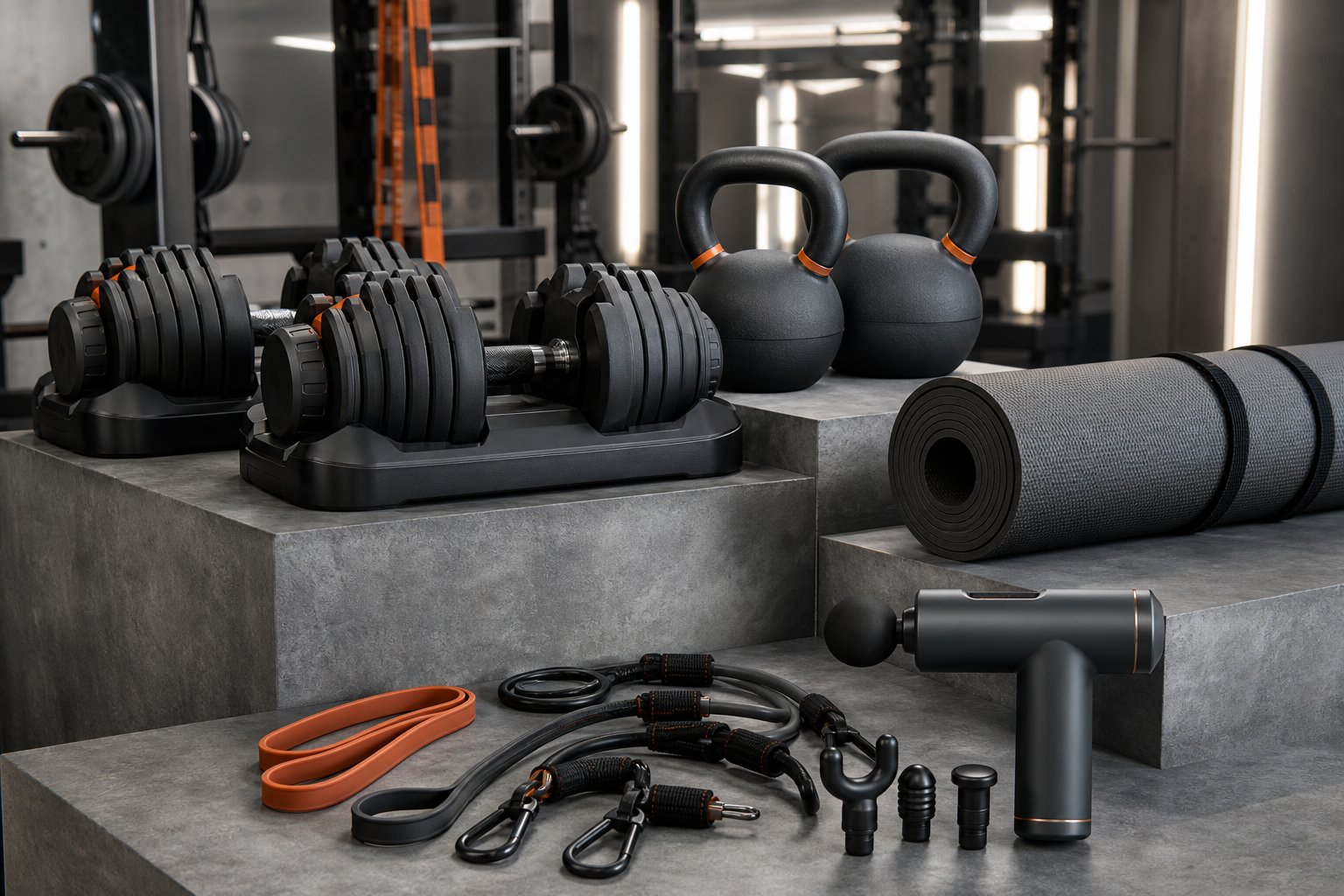
Most fitness buyers do not shop item by item; they shop by outcome — "I want to set up a home gym" or "I'm opening a small studio" — and a catalog that only sells individual SKUs forces that buyer to do the configuration work a good bundle would do for them. Five bundle tiers, built around real buyer profiles rather than arbitrary price points, cover roughly 80 percent of the purchase intents a fitness supplier sees: the minimalist starter, the garage gym, the home studio, the boutique studio, and the full commercial buildout. This guide lays out what belongs in each tier and why, so a bundle strategy sells faster than a catalog of disconnected SKUs ever could.
Tier 1: the minimalist starter
This tier serves the buyer testing whether home training will stick before committing real money or garage space: a set of resistance bands across 3-5 resistance levels, a yoga or exercise mat, and a pair or two of light dumbbells or kettlebells. Total unit cost is the lowest in the lineup, which makes it the highest-volume, lowest-margin-per-unit entry point into a fitness catalog, but it is also the bundle most likely to generate a repeat customer within six months once the buyer decides training is sticking and upgrades to Tier 2 — which is the real commercial argument for stocking this tier even at thin margins.
Tier 2: the garage gym
The fastest-growing buyer segment in home fitness adds a power rack, an Olympic barbell, a set of weight plates and an adjustable bench to the starter kit, turning a corner of a garage into a real strength-training space. This tier is where load rating and steel spec actually start to matter to the buyer, since these are pieces meant to last years under real training load rather than casual use — bundling the rack, bar and bench together at a package price, rather than pricing them separately, is what converts a browsing buyer who is intimidated by configuring a rack setup alone into a completed sale.
Tier 3: the home studio
Buyers converting a full room, not just a garage corner, add cardio equipment (a bike or rower fits smaller rooms better than a treadmill), a compact storage rack for accessories, and a recovery tool such as a foam roller or entry-level massage gun. This tier serves a buyer with a meaningfully higher budget and a longer decision cycle than Tiers 1-2, which means the bundle's presentation — photography showing a complete room setup rather than individual product shots — matters more here for converting the sale.
Tier 4: the boutique studio
Small commercial spaces running group classes need multi-station functional trainers or a small rack fleet, group-class small gear (bands, light dumbbells, mats in volume), and floor and mirror considerations that home buyers never think about but studio operators budget for from day one. This tier is a genuinely different sale — B2B, higher order value, longer sales cycle — and benefits from a dedicated quote process rather than a simple add-to-cart bundle, since studio buyers typically need financing conversations and delivery scheduling that home buyers do not.
Tier 5: the commercial buildout
Full gyms and large studios need the complete catalog at commercial load ratings: strength racks and multi-stations at Class S specification, a full cardio line, free weights through heavy dumbbell ranges, and increasingly a recovery corner (sauna, ice bath or massage devices) as a differentiator against competing gyms. This tier is the smallest by unit count but the largest by order value, and the buyers here are evaluating suppliers as much as products — production capacity, lead time reliability and after-sales parts supply matter more here than at any other tier.
Why pre-configured bundles outsell an item-by-item catalog
The underlying reason bundles convert better than an equivalent set of individually listed items is decision fatigue: a buyer who has to research and select six separate SKUs to build a home gym is far more likely to abandon the purchase partway through than one presented with a single "Garage Gym Package" that already answers the compatibility and sizing questions. Bundling does not require discounting — the value is in reducing the buyer's decision-making burden, and a well-photographed, clearly described bundle at full individual-item pricing still outconverts scattered SKUs, with margin improvement as a bonus rather than the primary mechanism.
| Tier | Core equipment | Buyer profile |
|---|---|---|
| 1. Minimalist starter | Bands, mat, light dumbbells | Testing home training |
| 2. Garage gym | Rack, barbell, plates, bench | Fastest-growing home segment |
| 3. Home studio | + Cardio, storage, recovery tool | Dedicated room buyer |
| 4. Boutique studio | Multi-station, group-class gear | Small commercial space |
| 5. Commercial buildout | Full Class S catalog | Gyms, large studios |
Conclusion
Five bundle tiers built around real buyer intent — not arbitrary price breaks — cover the large majority of purchase occasions a fitness supplier sees, and each tier's equipment list should reflect what that specific buyer actually needs rather than an upsell-driven grab bag. Tell us your target buyer mix and we will configure matching bundle SKUs with the right equipment list for each tier.
Frequently asked questions
Why do equipment bundles convert better than individual product listings? Bundles reduce decision fatigue by answering compatibility and sizing questions for the buyer upfront, rather than requiring them to research and select each SKU separately.
What separates a garage gym bundle from a home studio bundle? Garage gym bundles focus on strength basics (rack, barbell, plates, bench); home studio bundles add cardio equipment, storage and recovery tools for a dedicated room.
Do bundles need to be discounted to work? No — the primary value is reducing decision-making burden through clear, complete presentation; margin improvement from bundling is a secondary benefit, not the core mechanism.