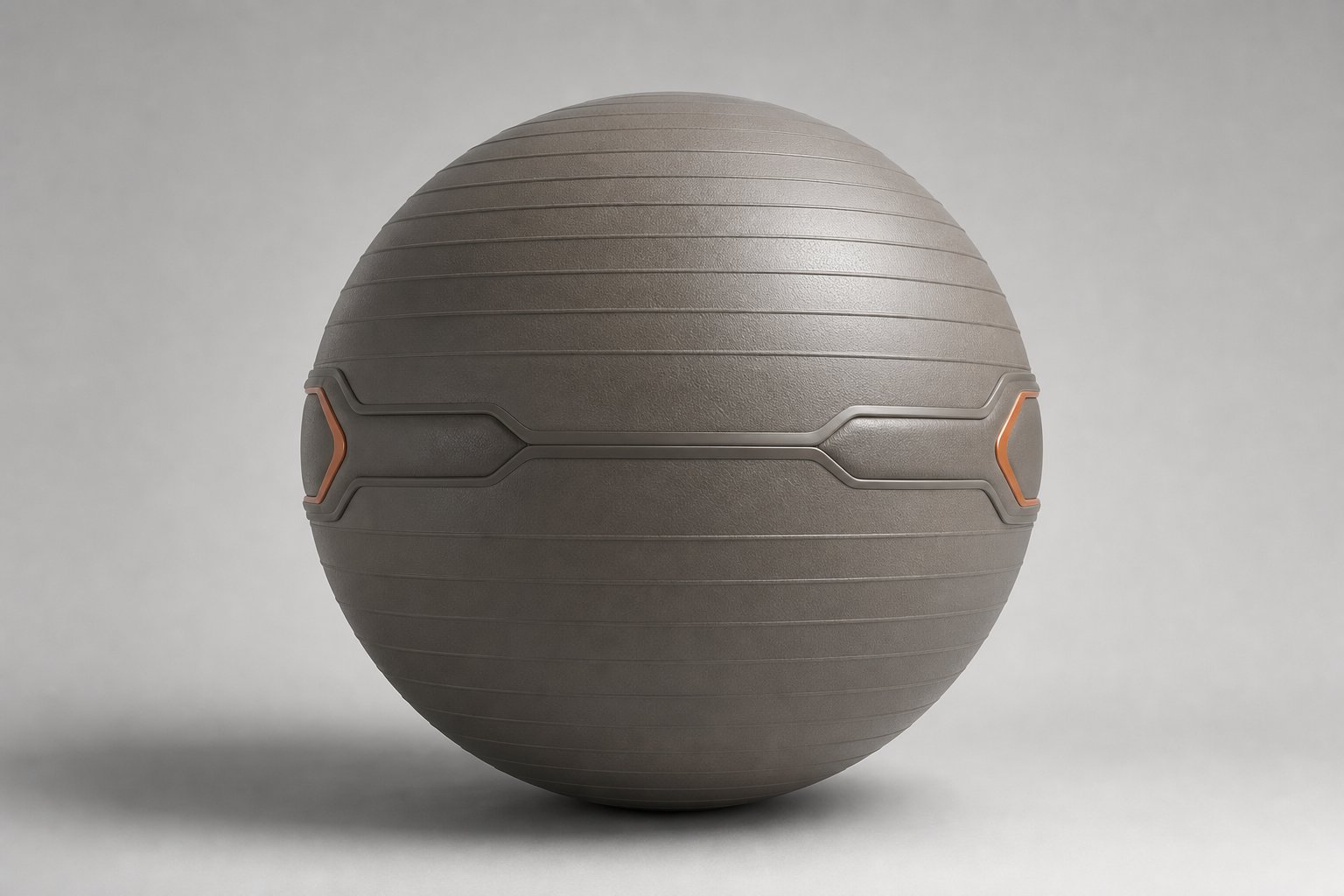
Exercise balls look like the simplest SKU in a fitness catalog, and that is exactly why sizing mistakes are common: buyers assume one size fits most, order the wrong diameter, and end up with knees above hip height in seated exercises or a ball too small to properly support prone core work. Two specs decide whether a ball performs and lasts: diameter matched to user height, and anti-burst rating under load. Both are simple to publish and both meaningfully cut return rates when they are.
Sizing by height, not by guesswork
The correct ball diameter is the one that lets a seated user's hips and knees form roughly a 90-degree angle with feet flat on the floor, which scales directly with height rather than following a generic small/medium/large label. Publishing a height-to-diameter chart with clear bands — 45cm for users under 1.5m, 55cm for 1.5-1.7m, 65cm for 1.7-1.85m, and 75-85cm for taller users — turns an ambiguous purchase into a confident one and is the single highest-leverage fix for this category's return rate, which is driven overwhelmingly by size mismatch rather than product defects.
Anti-burst rating: ask for the test, not just the number
"Anti-burst" is a real, testable claim, commonly rated to withstand static loads up to 300kg without sudden rupture — but the number is only meaningful with a stated test standard and PVC formulation behind it. Anti-burst performance comes from a combination of wall thickness and a PVC compound designed to deflate slowly through a puncture (rather than pop) when a sharp object does penetrate it; this slow-deflate behavior is a safety feature worth stating explicitly, since it is what prevents injury from a sudden collapse under load during a loaded exercise like a ball squat.
Surface texture and grip
Grip is one of those specs that photographs identically between a good and a bad product, which is exactly why it needs to be described in words rather than left to a product image to communicate. Ball surface finish affects both perceived quality and actual safety: a slightly textured, matte PVC surface provides meaningfully more grip for hands and feet during exercises like planks or wall squats than a glossy finish, which becomes genuinely slippery once a user starts to sweat, a failure mode that shows up quickly in any exercise involving bodyweight load against the ball's surface. This is a low-cost manufacturing choice that shows up disproportionately in reviews, and it is worth confirming with any supplier sample before committing to a production run.
Kit contents: what reduces first-use friction
A ball sold without a pump generates a predictable wave of first-use complaints, since most households do not own a ball pump and improvising with a bicycle pump is slow and frustrating. This single omission is disproportionately visible in one-star reviews relative to how cheap it is to fix, which makes it one of the highest-leverage, lowest-cost improvements available to any exercise ball catalog. Bundling a compact dual-action hand pump and, for studio-tier SKUs, a stability base ring that prevents rolling during setup or storage, removes friction at the exact moment a new customer forms their first impression of the product.
| User height | Recommended diameter | Typical use |
|---|---|---|
| Under 1.5m | 45cm | Home, rehab, seated balance |
| 1.5-1.7m | 55cm | General fitness, studio |
| 1.7-1.85m | 65cm | General fitness, studio |
| Over 1.85m | 75-85cm | Tall users, specialty |
Material thickness and PVC grade: what a low price usually cuts
Wall thickness on exercise balls typically runs 1.2-2.0mm depending on grade, and this single number correlates strongly with both anti-burst performance and how long a ball holds its shape under daily loaded use before developing a slow, hard-to-notice leak. Cost-reduced balls achieve a lower price point primarily by thinning the wall and using a lower-grade PVC compound with less plasticizer, which shows up months later as a ball that has visibly softened or lost roundness rather than as an immediate failure — a pattern that generates delayed complaints rather than immediate returns, which makes it easy for sellers to underestimate the problem until review scores start slipping. Requesting wall thickness in millimeters, not just an anti-burst weight claim, is the fastest way to separate a durable supplier from one built for a single order cycle, and it is a number every serious factory should be willing to put in writing without hesitation on a production sample, alongside the PVC compound name so batches stay consistent over repeat orders.
\nConclusion
Exercise balls only look simple. Publish a height-based sizing chart, state the anti-burst test standard behind the load rating, and bundle a pump, and this low-price SKU stops generating disproportionate return volume relative to its cost. Tell us your target user demographic and intended placement (home, studio or clinical) and we will recommend the matching size mix and anti-burst spec.
Frequently asked questions
How do I choose the right exercise ball size? Match diameter to user height using defined bands so that seated hips and knees form roughly a 90-degree angle, rather than relying on generic small/medium/large labels.
What does anti-burst actually mean? A PVC formulation and wall thickness designed to deflate slowly through a puncture rather than rupture suddenly, commonly tested to static loads up to 300kg.
Why include a pump with the ball? Most buyers do not own a ball pump, and omitting one generates predictable first-use friction and complaints.