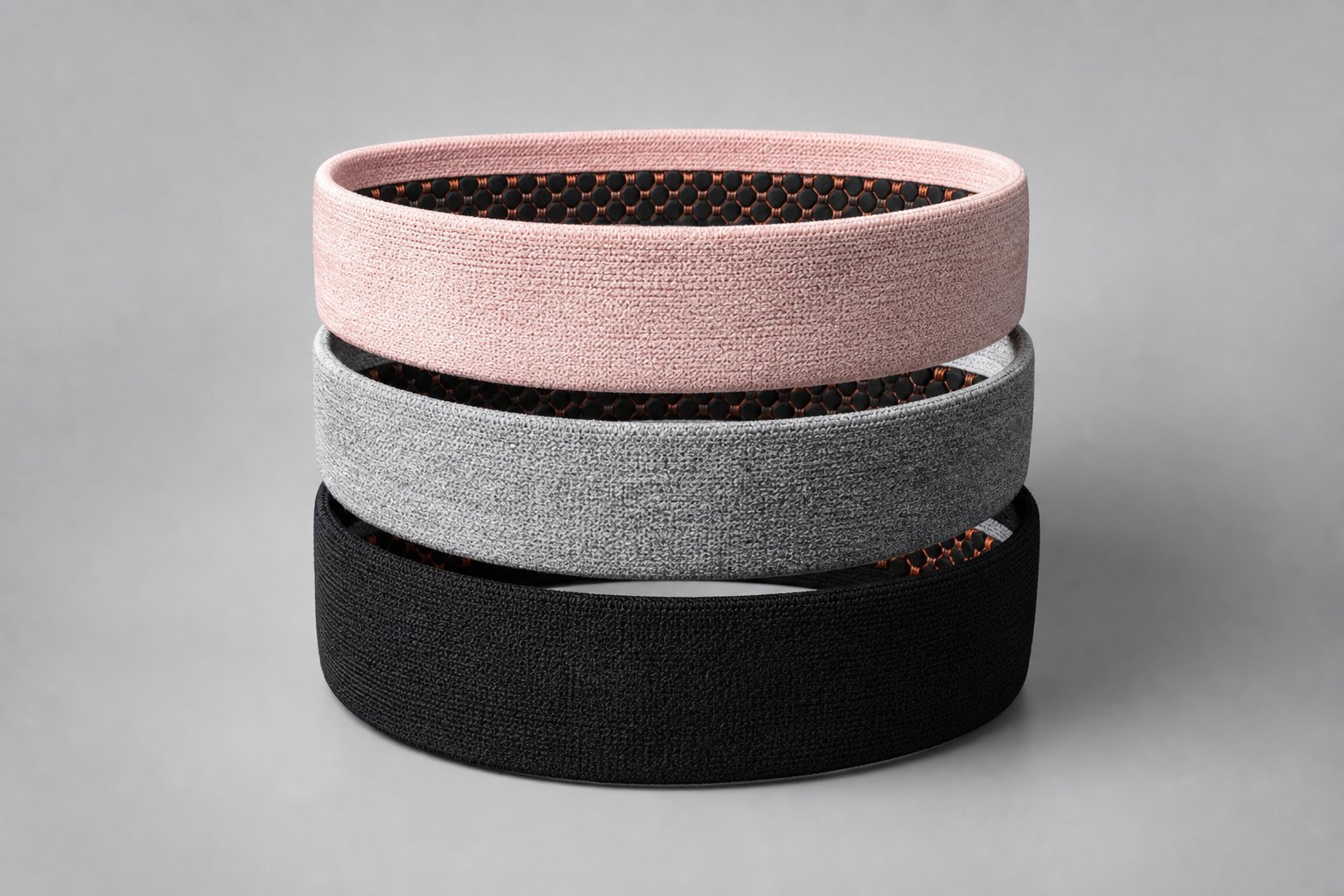
Mini bands and fabric hip bands look interchangeable on a shelf photo, and treating them as the same SKU is a common first-time seller mistake. They solve the same broad problem — activating and loading the glutes and hips in lateral and rotational movement — but the materials fail in opposite ways, and the buyer who wants one usually has clear reasons for not wanting the other. Stocking the right one first, or both with the difference explained, depends on understanding rolling behavior, skin contact and the social-content angle that has made this category unusually visible on short-form video.
Rolling: the complaint that defines this category
The single most common complaint about latex mini bands is rolling — the band creeping up the thigh during lateral walks or monster walks until it bunches into a thin cord that loses tension and pinches skin. This is primarily a material and manufacturing issue: a properly formulated natural latex with a wide, evenly finished edge resists rolling far better than a thin, cost-reduced compound, so band width and latex quality are worth specifying rather than assuming all latex bands perform identically. Fabric bands solve rolling structurally, with a wide woven body and a silicone-gripped inner lining that anchors against skin and clothing, which is precisely why they have grown fastest in the segment of buyers who tried latex bands first and were frustrated.
Skin contact and comfort over repeated use
Comfort during extended sets is an underrated purchase driver in this category, since buyers who train with bands daily notice small irritations that a single demo session would never reveal. Latex bands sit directly against skin and can pinch or chafe during longer sets, and a subset of users have latex sensitivity that fabric bands sidestep entirely since their skin-contact surface is woven fabric, not latex. Fabric bands are also machine washable, which matters for a product used at high sweat volume and reused across sessions — latex bands are typically wiped down rather than washed, and degrade faster with repeated stretching and UV exposure.
Resistance levels and product-line structure
How a supplier structures its resistance progression says as much about production discipline as it does about the product itself, since a consistent, well-labeled progression across a full set is harder to manufacture reliably than a single-resistance SKU. Latex mini bands are almost always sold as color-coded sets spanning 4-5 discrete resistance levels from a single low-cost mold, which makes them an efficient way to offer a full progression in one SKU. Fabric bands typically ship as 2-3 level sets (light, medium, heavy) at a higher unit cost, trading progression granularity for durability and comfort — a tradeoff worth explaining on a listing rather than leaving buyers to assume fabric bands offer the same fine-grained progression latex does.
The social-selling angle
Fabric glute bands have become disproportionately visible in short-form fitness content relative to their category size, partly because their patterned, colorful woven designs photograph better than plain latex loops and partly because the rolling-free performance makes for cleaner demonstration video. Sellers building a content-driven launch strategy should weight fabric bands accordingly, even though latex bands remain the more price-efficient entry point for bundle SKUs and first-time buyers unfamiliar with the category — the two strategies are not mutually exclusive within a single catalog.
| Spec | Latex mini band | Fabric hip band |
|---|---|---|
| Rolling resistance | Depends on formulation/width | Structurally resistant |
| Skin contact | Direct latex, sensitivity risk | Woven fabric, hypoallergenic |
| Washable | Wipe only | Machine washable |
| Resistance levels | 4-5 per set | 2-3 per set |
Packaging and bundle strategy: how the two lines actually sell together
The strongest-converting listings in this category rarely sell either band type alone; they bundle latex mini bands as the entry-level progression set and position fabric hip bands as a premium single-item upsell at checkout, which lets a buyer start cheap and trade up once they understand why the fabric version costs more. Packaging matters more than sellers expect here too — a small drawstring pouch or branded box for fabric bands reinforces the premium positioning that justifies the price gap, while latex sets are commonly sold in simple poly bags since their value proposition is price efficiency rather than presentation. Getting this packaging signal right on both SKUs reduces the perceived unfairness buyers sometimes feel comparing a bagged latex set to a boxed fabric one at a glance, and it costs very little relative to the margin uplift a well-presented upsell SKU delivers.
\nConclusion
Stock latex mini bands as the low-cost, high-progression entry SKU, and fabric hip bands as the premium, rolling-free, content-friendly upsell — the two serve different buyer priorities rather than competing for the same sale. Tell us your target price point and content strategy and we will recommend the matching mix.
Frequently asked questions
Why do latex mini bands roll up during use? Rolling is primarily a material and edge-finishing issue; a properly formulated latex with a wide, even edge resists rolling far better than a thin, cost-reduced compound.
Are fabric bands worth the higher price? For buyers who want zero rolling, machine washability and better social-content performance, yes; latex bands remain more price-efficient for entry-level bundles.
Can fabric bands offer the same resistance progression as latex sets? Typically no — fabric bands ship in 2-3 levels versus latex's common 4-5, trading granularity for durability and comfort.