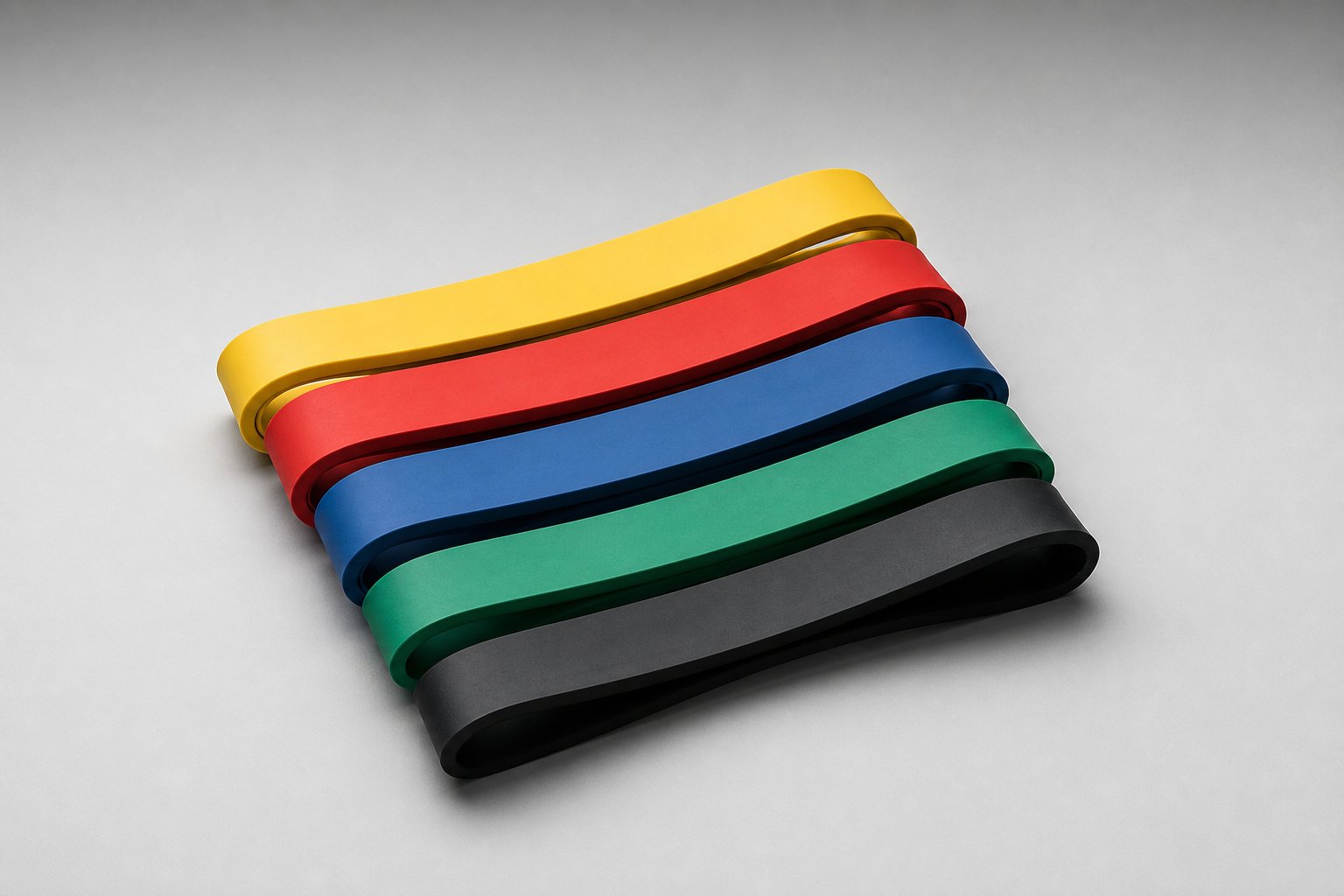
Resistance bands are the traffic entry of almost every fitness catalog: light enough to ship anywhere, cheap enough to trial, universal enough to sell in every market — and so commoditized that the listing, not the product, decides the winner. Inside that listing, one system quietly does the selling: the level color code. A five-level loop band set spanning roughly 5 to 175 lb is the global shape of the category — buyers recognize it instantly, progression content writes itself around it, and the color each market expects is nearly a language standard. But the code only sells if the levels are honest, and honesty here has a technical meaning: resistance in an elastic band is a function of stretch, so a level without a defined elongation is a mood, not a specification. Our resistance line is built on five-level natural latex loop sets with color-coded levels and rebound-decay cycle testing — because in a category this competitive, the tested band and the documented rating are the only moat available. This article explains the level system, the rating discipline that makes it trustworthy, and how to merchandise sets that compound instead of compete.
Why bands open the catalog
No other fitness product combines the commercial virtues of a resistance band: it weighs grams, ships in a padded mailer, survives international parcel networks without damage claims, costs little enough to be a first purchase, and photographs well enough to carry social content. That is why our category strategy positions bands as the traffic line — the SKU whose job is reviews, repeat visits and attach-rates rather than standalone margin. The economics work through the set: a five-level loop set turns one purchase into a progression system, progression systems generate content, content generates searches, and the searches land back on your listing. And because bands pair naturally with everything — mats, door anchors, tubes, mini bands — each band order is an invitation to a second basket. Treat bands as the top of a funnel, price them accordingly, and the category pays for itself in what it pulls through.
The five-level color code: the category's global shape
The market has converged on a recognizable standard: five loop bands of increasing resistance, color-coded by level, sold as a nested set with a carry bag and often an instruction card. Ours spans roughly 5 to 175 lb across the five levels — from warm-up-light assistance to heavy-duty strength work — with the exact per-band figures defined on the color card that ships with each set. Three merchandising rules follow. First, keep the set shape: buyers recognize the five-band fan in the gallery image before they read a word, and a nonstandard set count reads as something missing. Second, keep colors consistent across your own catalog and repeat orders — a returning customer buying a replacement expects the same green to mean the same pull. Third, print the level ranges on the product itself or the card: a band without a visible number forces the buyer to guess, and guessing is what reviews correct. The color code is not decoration; it is the interface through which the whole world already knows how to buy this product.
The honest rating: force at defined elongation
Here is the specification discipline most band listings skip, and it is the difference between a level system and a color scheme. The resistance of an elastic band is not a constant — it rises as the band stretches, and it depends on the band's dimensions, latex compound and wall thickness. A band that pulls "15 lb" somewhere in its working range will pull far less at a gentle stretch and far more near its limit. Honest sourcing therefore rates bands at defined elongation: force measured at a stated percentage of stretch, charted per level, printed on the color card. When you qualify a supplier, ask for exactly that — a force-versus-elongation table per band, not a single proud number on the box. Two corollaries: levels overlap, because a heavy band at low stretch can match a light band fully extended — which is why sets, not singles, are the honest product; and material matters — natural latex delivers the most consistent force curve across levels, while TPE-based bands trade consistency for price and latex-free positioning (our latex-versus-TPE article compares them for buyers with allergy-driven markets).
| Level | Position in the 5-175 lb set | Typical user | Typical use | Set role |
|---|---|---|---|---|
| Level 1 (lightest) | Lowest pull, warm-up range | Beginners, warm-ups, mobility sessions | Activation work, assisted stretches, light rehab-adjacent exercise | Entry point; most-used band in the set |
| Level 2 | Light | Beginner to intermediate | Full-body routines, glute and shoulder work | Volume workhorse |
| Level 3 | Middle | Intermediate | Strength circuits, assisted pull-up progression starts | Core of the set |
| Level 4 | Heavy | Intermediate to advanced | Power assistance, heavy glute and leg work | Progression target |
| Level 5 (heaviest) | Up to ~175 lb pull at range top | Advanced, pull-up assistance | Heavy assistance, added resistance for lifts | Cap of the progression ladder |
Per-band figures are defined by the color card shipped with each set; the table describes roles, not substitute specifications.
QC: what rebound-decay testing proves
An elastic band has one job — return force consistently, thousands of times — and one failure mode: going soft. Our resistance line runs rebound-decay cycle testing: bands are stretched repeatedly through their working range and force is re-measured, so the pull a buyer feels in month six can be defended, not just the pull on day one. Latex compound quality and wall-thickness consistency are the variables the test exposes; a band that sheds force quickly, or that shows whitening and surface crazing early, is built on reclaimed or under-specified stock. The same discipline covers surface finish (light talc, no oily residue), cut edges (clean, no nicks — a nick is where snaps begin) and color fastness (sweat is chemically active). One disclosure belongs in every honest listing: natural latex content, stated plainly for allergy-aware buyers, with TPE options positioned for latex-free markets. These are the checks that decide whether a band buyer returns for a second set or a refund.
Merchandising: sets, content and attach-rates
Bands sell through progression, so the content around them is the product. Three plays that compound. First, publish the progression: a simple five-level program — which band for which exercise at which stage — turns a color-coded set into a system and gives reviewers a vocabulary. Second, bundle by scene: bands plus a mat for the floor-work starter; loop bands plus mini bands plus fabric bands for the glute-focused buyer (our mini-band comparison covers the split); loop bands plus a door anchor for the home-gym-without-a-gym buyer. Third, ride the adjacent searches: assisted pull-up progression is the highest-intent query in the band universe, and our pull-up assist article maps the content route for it. None of these plays requires claims about medical outcomes — bands are training and recovery-assistance equipment, and listings should say exactly that, in plain training language, without promising treatments.
Conclusion
The five-level color code is the closest thing fitness accessories have to a universal language — and like any language, it only works when the words mean the same thing every time. Keep the set shape buyers recognize, rate levels at defined elongation with a card in every box, cycle-test the latex so the pull survives the season, and state latex content for the buyers who need to know. Do that, and bands stop being a commodity and start being the review engine and attach-rate engine of your catalog. Send us your market and the set configuration you have in mind, and we will return five-level specifications with rating cards, decay-test terms and indicative quotes from our resistance line.
Frequently asked questions
What does a five-level resistance band set cover? Our standard loop sets span roughly 5 to 175 lb across five color-coded levels, from warm-up-light to heavy assistance work. Exact per-band figures are printed on the color card that ships with each set — and honest listings state force at defined elongation, because band resistance rises as the band stretches.
Why do resistance bands lose their pull over time? Latex fatigue: repeated stretching past the working range, heat and ozone degrade the compound, and force output decays. Rebound-decay cycle testing at the supplier predicts which bands keep their pull; storage away from sun and heat preserves it.
Are latex or TPE bands better? Natural latex delivers the most consistent force curve and durability; TPE serves latex-free markets at a lower price with more consistency trade-offs. The choice is market-driven — our latex-versus-TPE comparison maps it by buyer segment.
How should bands be positioned in a store? As the traffic and attach-rate line: lead with the five-level set, publish progression content, and bundle by scene — with mats, mini bands, door anchors — rather than selling single bands as standalone margin plays.