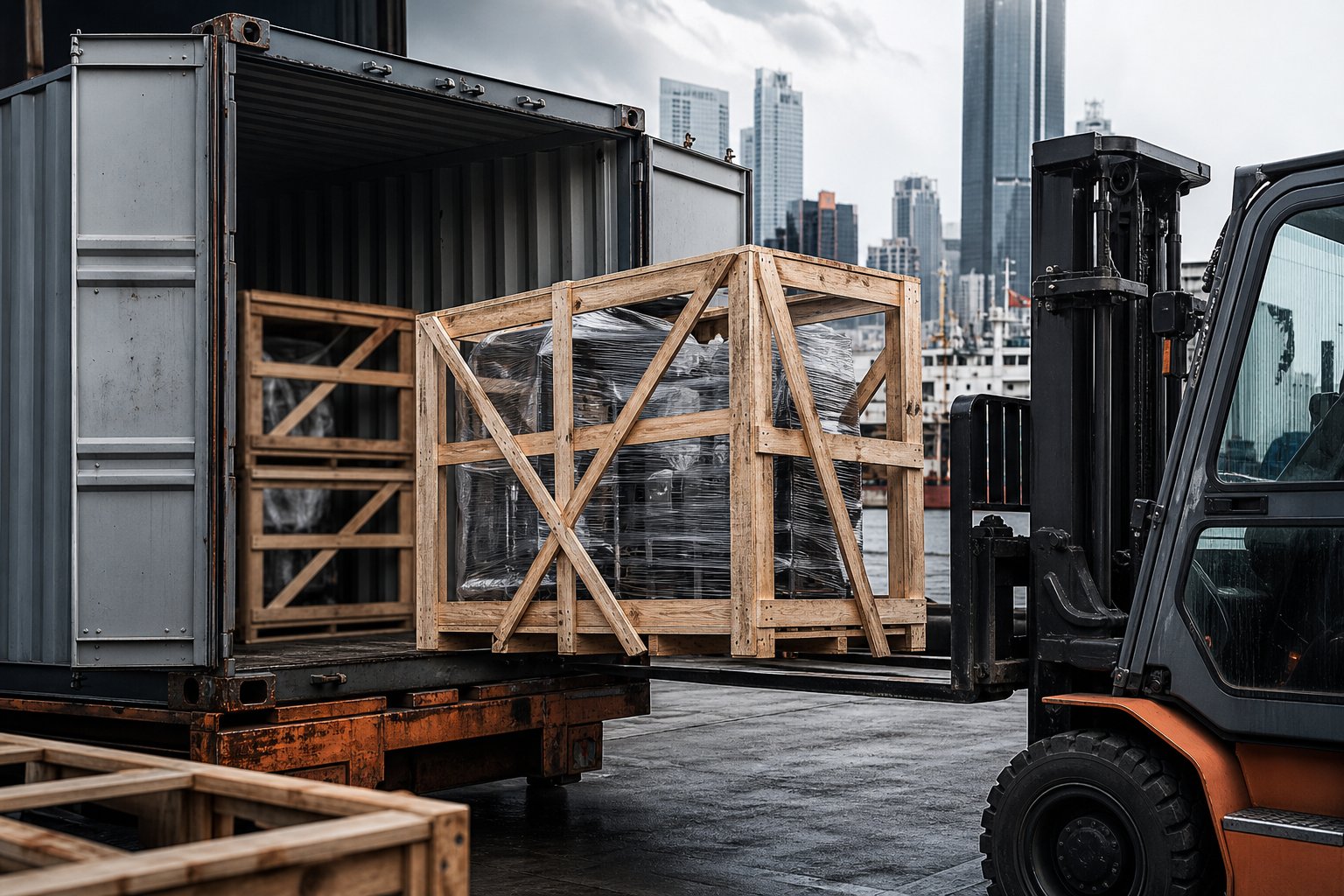
Quoting a per-unit freight cost without knowing how many units actually fit in a container is a common early-stage importer mistake, and gym racks — bulky, irregularly shaped, and often partially disassembled for shipping — are exactly the product category where a rough guess can be off by a meaningful margin. This guide walks through a practical loading calculation for a 40-foot high-cube (40HQ) container, the standard unit for most fitness equipment ocean freight, so buyers and sellers can estimate landed cost per unit accurately before committing to an order quantity.
Container dimensions: the starting numbers
A 40-foot high-cube container offers roughly 76 cubic meters of usable internal volume, with internal dimensions of approximately 12.03m length, 2.35m width and 2.69m height — figures that vary slightly by manufacturer but are close enough for planning purposes. The "usable" qualifier matters: door swing clearance, floor loading pattern and the practical reality that irregular shapes never stack with zero gap all reduce effective capacity below the theoretical maximum, which is why loading calculations should build in a realistic utilization factor rather than assuming perfect cubic efficiency.
Flat-pack versus assembled: the single biggest variable
How a rack ships — fully assembled, partially disassembled, or flat-packed with uprights, cross-members and hardware separated — is the single largest lever on how many units fit in a container. A fully assembled rack wastes enormous volume to its own frame's empty internal space; the same rack flat-packed into its constituent steel members and stacked densely can occupy a fraction of that volume. This is why serious fitness equipment exporters engineer packaging for disassembly rather than shipping showroom-ready units, even though it shifts assembly labor to the destination side — the container economics improvement typically outweighs the added assembly complexity for the buyer.
Weight versus volume: which constraint binds first
A 40HQ container's payload weight limit — roughly 26-28 tonnes depending on carrier, route and local road weight restrictions — can become the binding constraint before volume runs out for dense steel products like racks and plates, even though volume is the more commonly discussed limit. Calculating both the weight and volume utilization for a given SKU mix, rather than assuming volume is always the limiting factor, prevents the common mistake of planning a container load that looks fine cubically but exceeds weight limits and requires costly re-planning at the port.
A worked example: power racks flat-packed
A standard power rack, flat-packed with uprights nested and cross-members bundled, typically occupies roughly 0.15-0.2 cubic meters per unit depending on frame size, versus several times that volume if shipped assembled. Applying a realistic 80-85% utilization factor to the container's 76 cubic meters (accounting for stacking gaps and non-rack accessories sharing the load) yields a materially different — and far more useful — per-unit freight cost estimate than a naive volume-divided-by-container-size calculation, and is the kind of number a buyer should request explicitly from any supplier quoting a container price.
Mixed loads: combining SKUs to optimize both dimensions
A container loaded entirely with dense steel racks may hit its weight limit with volume to spare, while a container of bulky, light items like yoga mats hits volume limits with weight to spare — combining product categories with opposing weight-to-volume ratios in a single container load uses both constraints efficiently, which is the same logic covered in equipment-pairing planning but applied specifically to container-level freight optimization rather than merchandising.
What to ask a supplier before trusting a per-unit freight quote
Any per-unit freight cost quote should specify the packaging state assumed (flat-pack versus assembled), the utilization factor used, and whether the calculation was checked against both weight and volume limits — a quote that only states a per-unit dollar figure without these underlying assumptions is not verifiable and should be treated as an estimate rather than a firm number until confirmed. One further practical check worth making: confirm the carton dimensions actually fit through the container door opening, since door clearance is narrower than the container's internal width and height, and a carton designed to nest efficiently inside can still require awkward angled loading at the door if nobody checked this constraint at the packaging design stage — a five-minute carton-to-doorway comparison that costs nothing now and prevents an expensive loading delay later.
| Packaging state | Volume per rack (approx.) | Relative container efficiency |
|---|---|---|
| Fully assembled | 0.8-1.2 m³ | Low |
| Partially disassembled | 0.35-0.5 m³ | Medium |
| Flat-packed | 0.15-0.2 m³ | High |
Conclusion
Container loading efficiency for gym racks depends more on packaging engineering than on the container itself, and a per-unit freight estimate is only as trustworthy as the packaging-state assumption behind it. Ask suppliers for flat-pack dimensions, realistic utilization factors, and confirmation against both weight and volume limits before locking in an order quantity. Send us your target rack model and order volume and we will calculate a matching container plan.
Frequently asked questions
What is the usable volume of a 40HQ container? Roughly 76 cubic meters, though realistic utilization after accounting for stacking gaps and clearance is typically 80-85% of that figure.
Why does flat-pack shipping matter so much for gym racks? A fully assembled rack wastes volume to its own empty internal frame space; flat-packed into constituent steel members, the same rack occupies a fraction of that volume.
Can weight limits bind before volume limits for fitness equipment? Yes — dense steel products like racks and plates can hit a container's roughly 26-28 tonne payload limit before its volume is fully used.