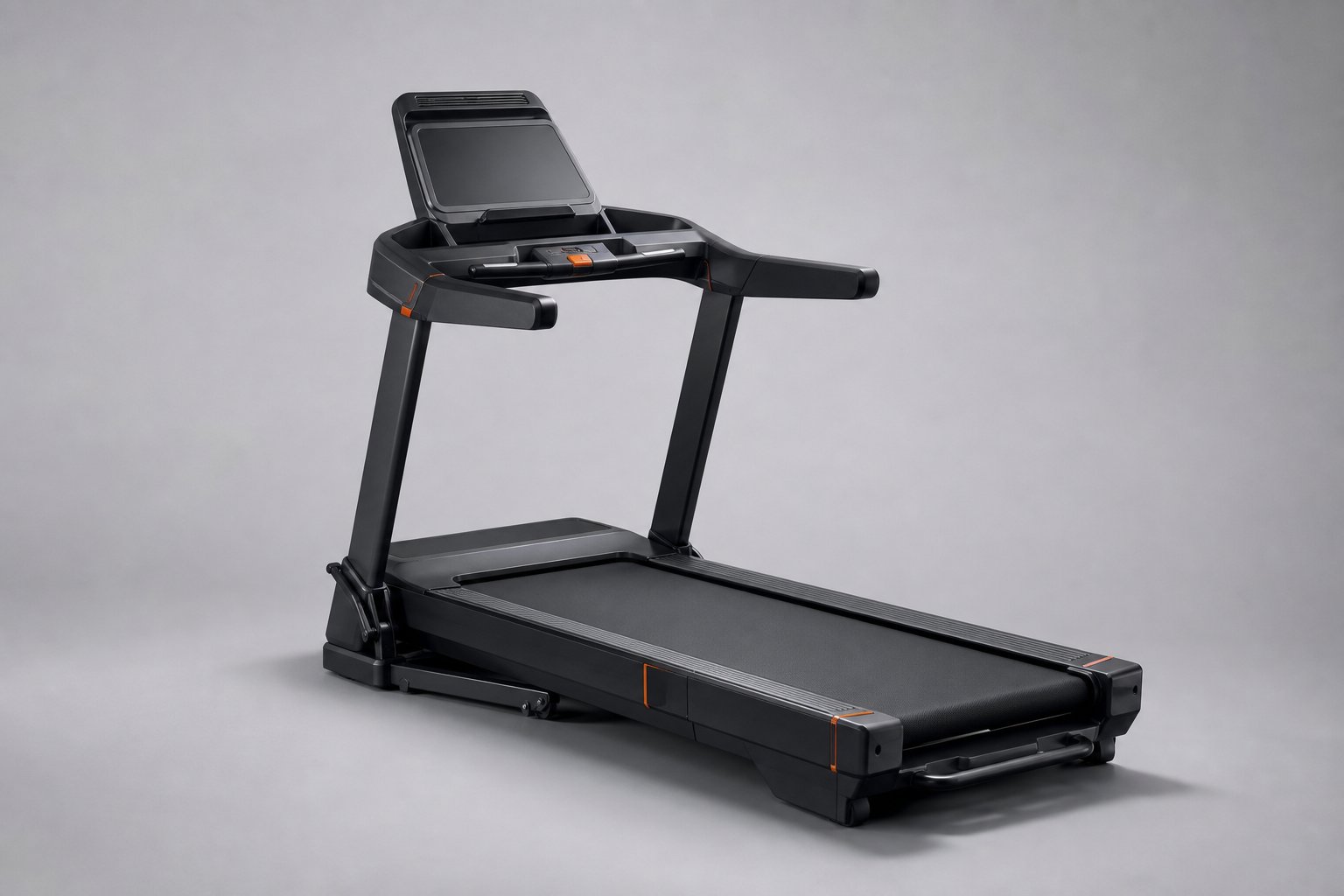
Horsepower is the most abused number in the treadmill business. The same folding machine that one listing calls a 2.5 HP treadmill, another calls a 5 HP treadmill — and both listings are describing the identical motor. The trick is the rating basis: one number describes what the motor sustains for an hour of running, the other describes a momentary surge at startup or at full incline. Sellers who understand the difference can read any treadmill quotation in a minute, price their listings against honest competitors instead of inflated ones, and — more importantly — avoid the warranty and review damage that oversized claims eventually cause. This guide explains continuous versus peak ratings, shows what our home and light-commercial lines actually rate, lists the companion specs that matter as much as horsepower, and gives you a red-flag checklist for spotting inflated claims in supplier quotes and competitor listings alike.
Continuous versus peak: the two numbers and why only one matters
Continuous horsepower is what the motor delivers steadily, thermally, over a sustained run — the number that determines whether the machine feels strong in minute forty of a jog. Peak horsepower is what the motor produces for a moment: startup, a sudden speed change, maximum incline with a heavy user. Because electric motors tolerate brief overloads far beyond their continuous rating, the peak figure is always larger, and the gap between the two is exactly where marketing lives. A listing that quotes only peak HP is not lying about a number; it is lying about which number answers the buyer's question. When you evaluate any treadmill quote, force the dual rating onto the table: continuous and peak, separately, with the test condition stated. Suppliers who volunteer both are telling you their QC can defend the numbers; suppliers who resist are telling you which number would shrink.
What honest lines actually rate
Our home folding line uses DC motors rated 2.0 to 2.5 HP continuous — the honest operating band for walking, jogging and interval running by typical home users, paired with a declared maximum user weight. The light-commercial line rates 3.0 to 4.0 HP continuous for studio duty cycles: longer runs, more users per day, higher average speeds. Two nuances make these bands meaningful rather than decorative. First, rated user weight interacts with horsepower: a 2.0 HP machine carrying a heavier runner works closer to its thermal ceiling, so heat, noise and wear all rise together. Second, duty cycle is a commercial-line concept — eight hours of near-continuous use is a different thermal problem than a household's forty minutes, which is why jumping a home machine into studio placement fails even when the HP figure looks adequate. State both the rating and the intended placement, and the spec becomes an engineering statement instead of a slogan.
The company horsepower keeps: belt, noise and build quality
Horsepower only means something in a system, and the four-parameter honest spec treats it that way: motor dual rating, running belt layers, noise in decibels and rated user weight. The belt matters because the motor drives a mechanical system, not a number — a multi-layer belt with a low-friction surface lets a modest motor deliver a smooth, quiet run, while a thin single-layer belt wastes power as friction and heat. Noise is the spec buyers test first and the one factories cannot fake after arrival: our listings carry measured decibel figures, and a machine whose noise claim survives a home audit is a machine whose other claims tend to survive too. Build quality completes the system: copper windings in the motor run cooler and last longer than aluminum-substitute windings, and they are the kind of detail a supplier either specifies proudly or omits — which itself is information. Ask for the motor's winding material, the controller's thermal protection and the belt's layer count in the same email as the HP figures; honest suppliers answer all four without a pause.
| Spec item | Home folding line | Light-commercial line | Why it matters |
|---|---|---|---|
| Motor rating | DC 2.0–2.5 HP continuous (+ peak stated) | 3.0–4.0 HP continuous (+ peak stated) | Continuous HP is the performance number |
| Rated user weight | Declared per model | Declared per model | HP and user weight work as a pair |
| Running belt | Multi-layer, low-friction surface | Multi-layer, higher duty | Friction wastes HP as heat and noise |
| Noise | Measured dB, stated in listing | Measured dB, stated in listing | First spec buyers verify at home |
| Duty cycle | Household sessions | Studio hours per day | Placement mismatch kills warranties |
| Usage class | Class H per EN ISO 20957-6 | Class S per EN ISO 20957-6 | The standard's own home/commercial split |
Red flags: how inflated listings give themselves away
Inflated horsepower claims share a pattern, and once you have seen it you cannot unsee it. A single HP number with no continuous/peak split. A home folding machine claiming numbers that would embarrass a light-commercial deck. A spec sheet that omits rated user weight — because user weight is where the motor rating meets physics. Marketing adjectives where decimals should be: commercial-grade, super-strong, high-power. And the quietest flag: no noise figure, because noise is the claim most easily tested by the customer in their living room. Demand the four-parameter spec and the red flags disappear from your own listings as a side effect — which matters, because the returns and reviews inflated claims generate do not land on the supplier; they land on the store whose name is on the box.
The market keeps growing; honest specs keep the reviews
The commercial backdrop makes this discipline worth the effort. Grand View Research projects the global treadmill market growing from USD 3.3 billion in 2023 to USD 5.6 billion by 2030, an 8.1 percent CAGR — and the volume behind that curve is visible in trade data: 16.74 million treadmill units exported in 2024 under the broad industry scope, per the China Sport Show industry report. Supply concentration is equally real: in Xiamen's Tong'an cluster, which produces roughly six of every ten home treadmills made in China, core components can be sourced within a three-kilometer radius. Depth of supply means every spec tier is available at every price — which is precisely why the honest-spec listing wins: when hardware is abundant, credibility is the scarce asset, and credibility is what five-star reviews about a quiet, strong motor are made of.
Conclusion
Horsepower is a system property, not a sticker. Continuous rating answers the buyer's question; peak rating inflates it. Belt layers, noise figures, rated user weight and winding material tell you whether the HP number is engineering or theater. Put the four-parameter spec on every listing, demand it from every quote, and your treadmill line will collect the one asset this growing market cannot oversupply: reviews that confirm the claim. Send us your market's user profile and price band, and we will quote home and light-commercial treadmill lines with the full dual-rating spec sheet attached.
Frequently asked questions
What is the difference between continuous and peak horsepower? Continuous HP is what the motor sustains thermally over a long run; peak HP is a momentary surge at startup, speed change or maximum incline. Only the continuous figure predicts running performance, so always demand both numbers with the continuous figure first.
How much horsepower does a home treadmill actually need? Our home folding line rates 2.0 to 2.5 HP continuous, which covers walking, jogging and interval running for typical home users at the declared maximum weight. Light-commercial placement starts at 3.0 to 4.0 HP continuous for studio duty cycles.
Why does rated user weight matter as much as horsepower? A heavier runner pushes the motor closer to its thermal ceiling at any given speed, raising heat, noise and wear together. A treadmill without a rated user weight is hiding the condition under which its HP figure is true.
How can I tell if a supplier's HP claim is inflated? Look for the pattern: a single number with no continuous/peak split, no rated user weight, adjective-heavy specs and no noise figure. Ask for copper windings, thermal protection and belt layers in the same question — honest suppliers answer all of them without hesitation.