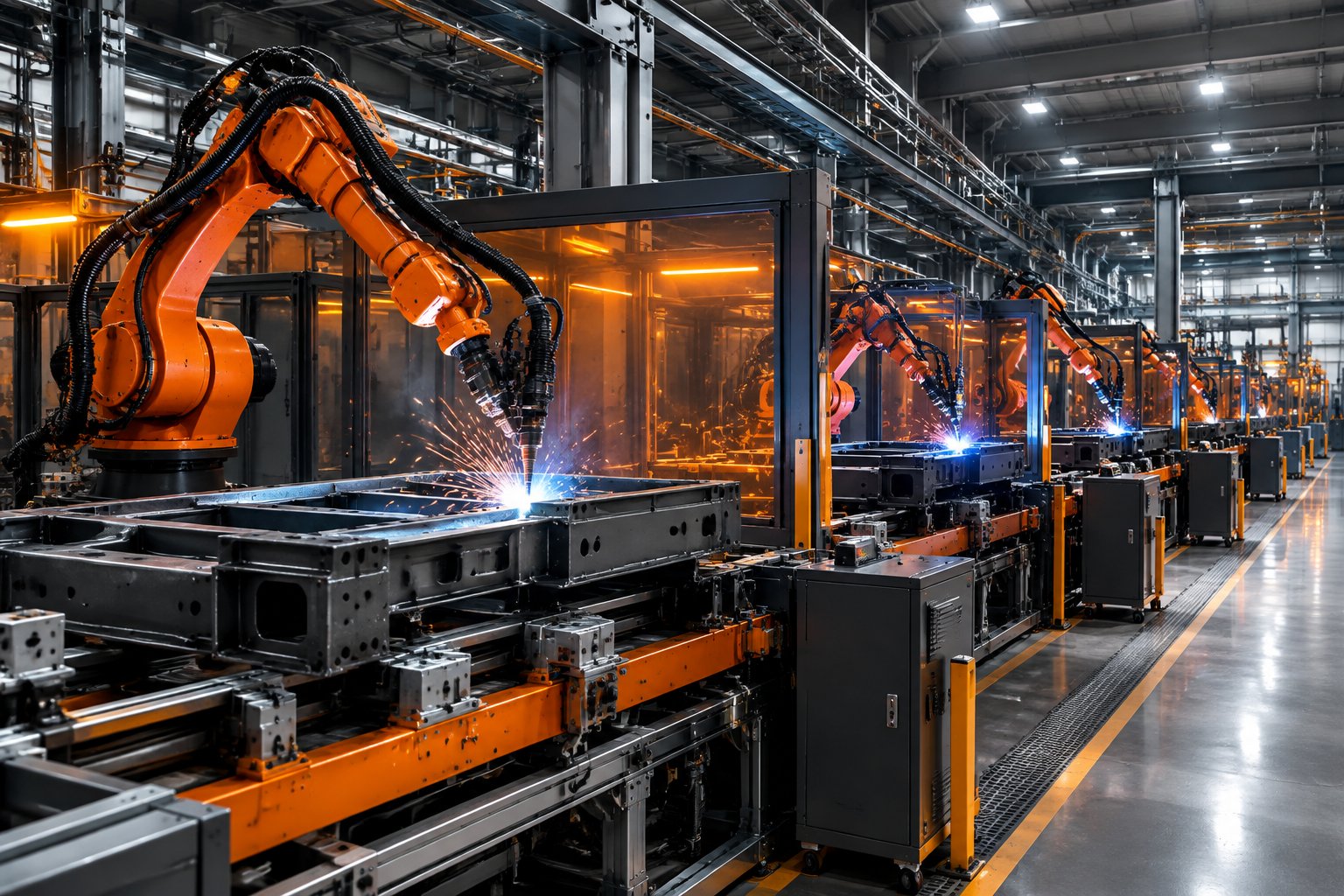
Ask where a fitness product is made and you have already asked whether it will be any good. Chinese gym equipment is not produced by a generic national industry; it is produced by a handful of regional clusters, each with its own specialty, supplier density and export track record — and the belt a product comes from determines the tooling behind it, the parts radius around it and the engineering depth behind your spec. Buyers who ignore the map negotiate harder with the wrong factories; buyers who read it match every category to the ground that grows it best. This article maps the six belts that matter, with the published numbers behind each — from Ningjin's 70 percent share of commercial equipment to Yongkang's home-cardio speed — plus the adjacent specialty belts for braces and massage equipment.
Why the belt matters more than the factory name
A cluster is an Invisible Bill of Materials. In a mature belt, the steel, bending, welding, powder coating, bearings, packaging and tooling shops sit within driving distance of each other, so a factory is really an integrator standing on dense local supply. That density shows up in three buyer-visible ways: shorter development loops because tooling and sample shops are near; deeper parts continuity because a worn pulley or a steel gauge change is a local errand, not a procurement project; and price stability, because freight between process steps is a taxi ride. This is why a category sourced inside its home belt usually outperforms the same category sourced wherever the quote is lowest. Xiamen's official investment-promotion platform puts a number on the density: 80 percent of core fitness equipment components can be assembled within a 3-kilometer, 30-minute radius, and nearly 90 percent of materials are locally sourced.
The six-belt map at a glance
| Belt | Region | Specialty | Key published figures |
|---|---|---|---|
| Ningjin | Dezhou, Shandong | Commercial strength and cardio | 70% national commercial share; 2,986 companies; 13.9bn yuan output (2024); exports near 10bn yuan; sells to 170+ countries |
| Xiamen | Tong'an/Haicang, Fujian | Home treadmills and cardio | Asia's largest export base; 6 of 10 home treadmills; only national export quality-safety demonstration zone; 3km/30min for 80% of core parts |
| Qingdao | Jimo/Chengyang, Shandong | Export-oriented listed makers | Impex overseas revenue 76.92% (2025 annual report); Sportsoul, the trampoline-first IPO |
| Pizhou | Xuzhou, Jiangsu | Strength machines, multi-stations | Kangliyuan (301287), first ChiNext-listed fitness equipment maker; exporting since 1989 |
| Dingzhou | Hebei | Sports and fitness goods, small/medium items | 400+ enterprises, 100,000+ workers, 10bn+ yuan output, ~15% national share, exports to 50+ countries |
| Yongkang/Wuyi | Jinhua, Zhejiang | Home cardio, small equipment | April 2023 single-month fitness equipment export growth above 63% |
Ningjin: where commercial strength lives
The numbers behind Ningjin are unusually well documented because they carry central-media backing. People's Daily, Xinhua and Securities Times all report the same core facts: the county supplies about 70 percent of China's commercial fitness equipment — in the trade's shorthand, seven of every ten commercial machines are Ningjin-made — across 2,986 registered companies, with 2024 industrial output passing 13.9 billion yuan and exports near 10 billion yuan, sold to more than 170 countries and regions. The product range spans more than 400 series and over 1,000 varieties, from racks and smith machines to treadmills and rehabilitation equipment.
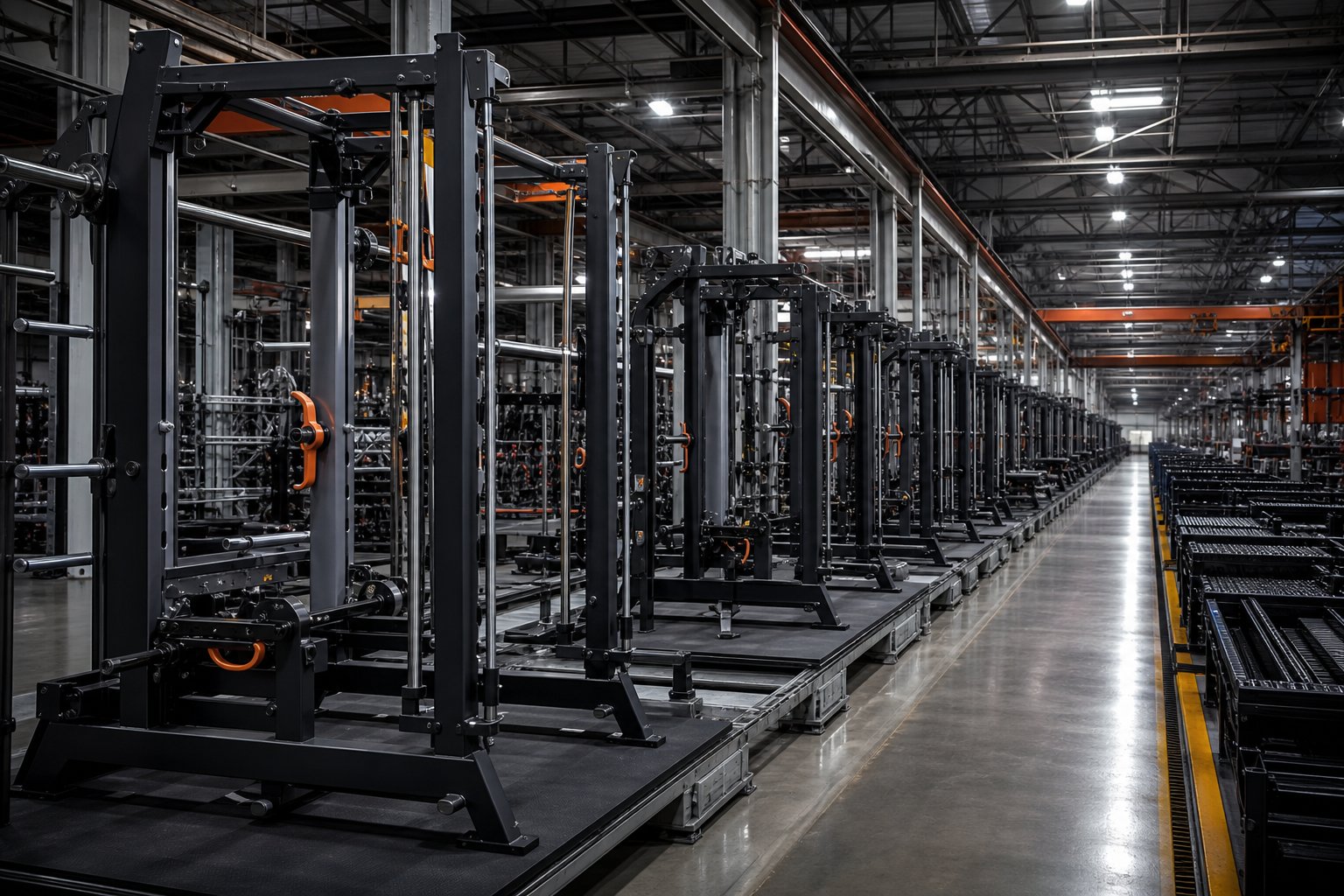
For a buyer, the practical meaning is bench depth. A county with thousands of factories doing the same category has, somewhere in it, a factory at your exact spec-and-price point, plus the process ecosystem the eight-step production line assumes — laser cutting, CNC bending, robot welding, shot-blasting, powder coating, curing, assembly and packing. When we quote a commercial rack line, this is the ground it stands on.
Xiamen: the home-cardio export machine
If Ningjin is the commercial anchor, Xiamen is the household one. Tong'an district is described by the Xiamen investment-promotion center as Asia's largest fitness equipment manufacturing export base and the only national-level export fitness equipment quality-safety demonstration zone in China — a customs-administered designation, which is what makes it hard evidence rather than a slogan. The cluster's headline ratio: about 6 of every 10 home treadmills sold in China are Xiamen-made. Anchor manufacturers scale into the millions of units a year — the major Haicang OEM plants publicly cite capacity around 2 million units annually — and the component radius keeps the belt responsive.
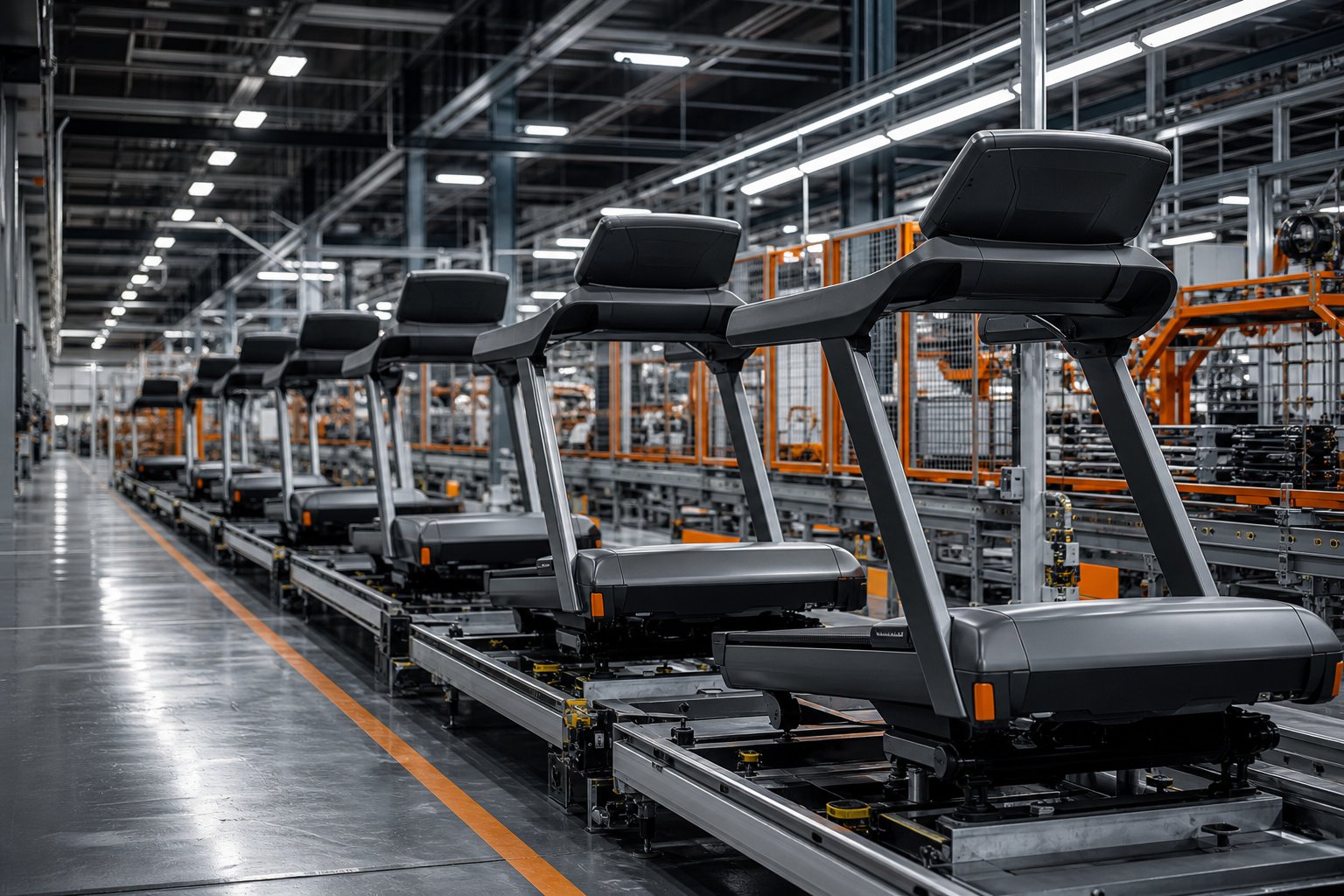
For walking pads and folding treadmills, sourcing here means the four honest parameters are negotiated with suppliers who produce them at export volume daily.
The northern and eastern trio: Qingdao, Pizhou, Dingzhou
Qingdao's Jimo and Chengyang districts are where export-oriented manufacturing became listed companies: Impex (002899), whose 2025 annual report puts overseas revenue at 76.92 percent of sales, and Sportsoul (001300), the trampoline-sector's first IPO, both anchor a belt of 68 export enterprises in Jimo alone as of the customs data published in 2020. This is the ground where OEM-grade quality systems are the local default — useful context when a buyer asks who else produces at that standard.
Pizhou, in Jiangsu's Xuzhou prefecture, is the strength-line belt: Kangliyuan (301287) became the first ChiNext-listed fitness equipment company, on a production-and-export history dating to 1989, with multi-stations and free-weight machines as the leading categories. Dingzhou, in Hebei, is the scale generalist: more than 400 sports goods enterprises, over 100,000 workers, annual output above 10 billion yuan, roughly a 15 percent national share, and exports to more than 50 countries — including the Olympic javelins made by Yinjian. Yongkang and neighboring Wuyi in Zhejiang ride the hardware province's supply base for home cardio and small equipment; the belt's April 2023 single-month export growth above 63 percent signaled how fast home-fitness orders can move through it.
The adjacent specialty belts
Two more clusters complete the recovery-side map. Yangzhou's Xiaoji town in Jiangsu produces roughly 60 percent of China's sports braces and supports — the knitted-brace supply chain runs from yarn to finished sewing there. Jizhou in Hengshui, Hebei hosts 300-plus medical-rehabilitation device enterprises, the medical-grade end of the supports category. And Xiamen doubles as a massage-equipment belt: OGAWA's Tong'an base publicly cites annual capacity of 700,000 massage chairs with 15 consecutive years as the industry's export leader by revenue — which is why our massage and recovery line sources along the same coastal corridor as our home cardio.
Using the map as a buyer
The map converts into a sourcing rule: match the category to its belt, then choose the factory inside it. Commercial strength and light-commercial cardio point to Ningjin; home treadmills, walking pads and ellipticals to Xiamen; strength stations and multi-gyms to Pizhou; braces to Yangzhou with Jizhou for medical-grade; small and mid-size goods benefit from Dingzhou and Yongkang. The catch is that few buyers want six supplier relationships across six provinces — which is the gap a supply chain partner exists to close: one QC standard, consolidated mixed-container loading across belts, and one accountable counterpart for spares and after-sales. Our catalog is organized exactly this way, category by category, on the belt that grows each best.
Conclusion
China's fitness equipment industry is a map before it is a market. Ningjin's 70 percent commercial share, Xiamen's 6-in-10 treadmills and quality-safety zone designation, Qingdao's listed exporters, Pizhou's strength heritage, Dingzhou's scale and Yongkang's speed are not slogans; each carries published figures and official sources. Read the map first, then buy inside the right belt. Send us your category list and we will show you, belt by belt, where each line sources and why — 参考 MOQ from 100 units on stocked private-label goods.
Frequently asked questions
Where is most commercial gym equipment made in China? In Ningjin county, Shandong: about 70 percent of China's commercial fitness equipment, per People's Daily, Xinhua and Securities Times reporting in 2025, from a base of 2,986 companies with 2024 output above 13.9 billion yuan.
Where do home treadmills come from? Predominantly Xiamen, Fujian: about 6 of every 10 home treadmills sold in China are made there, in Asia's largest fitness equipment export base and the country's only national-level export quality-safety demonstration zone for the category.
Which cluster is strongest for free weights and strength machines? Strength stations and multi-gyms center on Pizhou, Jiangsu — home of Kangliyuan, the first ChiNext-listed fitness equipment maker — while Ningjin's commercial ecosystem and Shandong's plate-and-dumbbell foundries cover racks and free-weight programs.
Can one supplier cover several belts? Directly, rarely; through a source supply chain partner, routinely. A consolidation partner applies one QC standard across belts, loads mixed containers from several clusters and keeps spares and after-sales under one contract — which is how our nine-category catalog is organized.