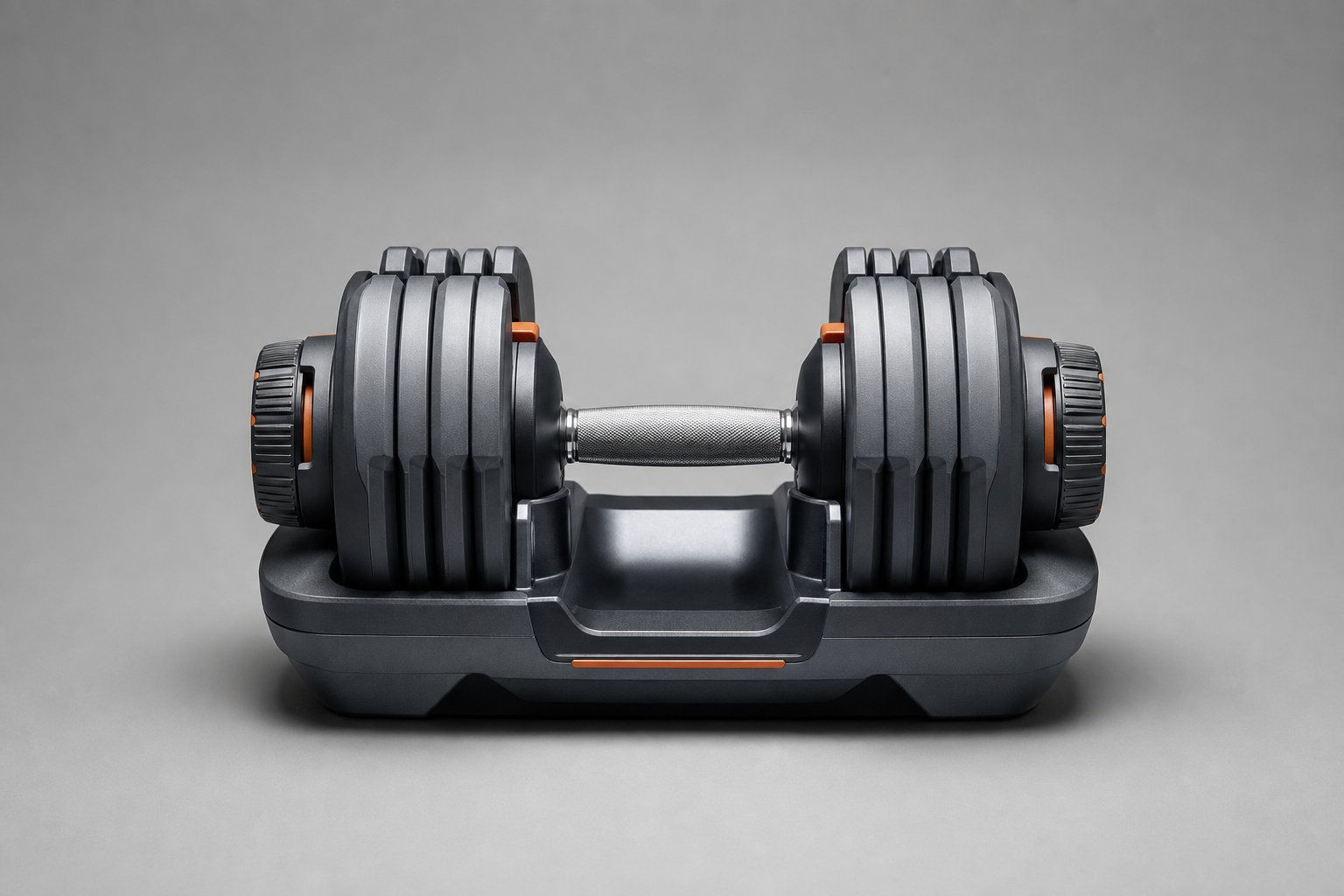
Adjustable dumbbells are the highest-leverage SKU in the home-strength category: one product replaces a whole rack of fixed pairs, which is exactly why apartment buyers want them and why the category keeps growing with the home fitness market — forecast to rise from USD 12.88 billion in 2025 to USD 22.99 billion by 2034 (Fortune Business Insights). But the same mechanism that creates the value creates the risk: a selector that jams, a plate that does not seat, a dial that strips — these turn a margin hero into a returns leader faster than almost any other defect in free weights. Our free-weights line treats adjustable dumbbells as a mechanism product first and a weight product second: plate weight error is batch-inspected like any other iron, and the selector assembly is the part we qualify hardest. This article walks through the three mechanism families, the failure points behind most negative reviews, how to choose weight ranges and increments for your channel, and the logistics reality of shipping what is, in the end, a heavy parcel.
Why adjustable dumbbells anchor the home line
Three forces converge on this product. Space: the buyer lives in an apartment where a dozen fixed pairs is a fantasy; one tray under the bench is not. Money: replacing a full rack with one SKU concentrates budget into a product whose price point — and margin — sits far above entry fixed pairs. Momentum: home use accounts for 51.1 percent of global fitness equipment revenue (Grand View Research, 2025), and strength retained its post-boom audience while novelty gadgets faded. Together these make adjustable dumbbells the natural mid-ticket anchor of a home catalog: above accessories in AOV, below racks in freight complexity, and genuinely differentiated by engineering rather than by color. That differentiation is also the trap — because when two listings look identical in photos, the difference lives inside the selector mechanism, where the buyer cannot see and the reviewer certainly can.
The three mechanism families
Every adjustable dumbbell on the market selects plates with one of three approaches, and each buys something and pays for it:
| Mechanism | How it selects | Strengths | Watch-outs | Channel fit |
|---|---|---|---|---|
| Dial (rotating handle) | Turn the handle; slots align to drop unselected plates in the tray | Fastest switching, clean look, strong retail story | Dial and slot parts are precision components; abuse and drops hit hardest; must be seated in tray to change | Premium home e-commerce |
| Lever / slider | Flip a lever or slide a bar to lock selected plates | Robust feel, simple parts, tolerant of gym-bag life | Slightly slower changes; lever play can develop | Home and light commercial |
| Pin / spinlock | Loosen a collared pin, add or remove plates manually | Fewest parts, lowest cost, easiest repairs | Slowest changes; user must tighten properly | Budget home, starter sets |
There is no universally best mechanism — there is a best mechanism for a channel. A dial suits a buyer who changes weight every set and values speed; a lever suits a buyer who drops the dumbbell back on the tray between tasks and values indestructibility; a pin suits a starter buyer whose benchmark is price. The expensive mistake is buying a dial-tier product at pin-tier prices and discovering, in reviews, where the cost went.
Failure points: where the reviews come from
Negative reviews of adjustable dumbbells cluster around the mechanism, and almost all of them trace to four causes. First, drops while plates are selected: nearly every dial and lever design assumes the user lifts vertically and sets down gently; a lateral drop with plates selected can skew rails or crack selector components, and no warranty covers that gracefully. Second, plastics in the load path: the cheapest assemblies put load-bearing duty on plastic bushings or selector teeth; they work new and fail at month eight. Third, misalignment: rails bent in transit or trays warped by stacking make plates jam — which is why export packaging with foam-locked trays is not a luxury. Fourth, dirt and sweat ingress in dials: fine debris under the dial degrades the click-stop action over months. When we qualify an adjustable dumbbell, the selector assembly goes through repeated switching-cycle checks and the set goes through batch weight-error inspection; ask any supplier you use for both, in writing, with the tray packed as it will ship.
Weight ranges and increment strategy
Top-end weight sells the listing; increments decide the reviews. Progression in dumbbell training lives in small steps — press, row and curl progressions move in jumps a shoulder can absorb — so sets that step in fine increments near the working weights score better with serious users, while sets that jump coarsely feel cheaper than their peak number suggests. As market structure (our sourcing observation, indicative): consumer sets commonly run from a few kilograms up to around 20-25 kg per hand, with flagship tiers above that; pairs at the top end cross heavy-parcel thresholds quickly. A practical catalog play is two tiers: a mid-range set covering beginner-to-intermediate progression as your volume SKU, and a higher-range set as the upgrade path — the second sale to the same customer is far cheaper than the first. Publish the increment ladder and the per-hand maximum plainly; both are the first numbers spec-literate buyers check.
Logistics and after-sales: treat it like the heavy parcel it is
An adjustable pair with its tray is a dense, awkward, fragile-if-mishandled parcel, and the carrier math is unforgiving: USPS caps parcels at 70 lb (about 31.8 kg), UPS and FedEx at 150 lb, and handling surcharges begin near 50 lb (about 22.7 kg), per eFulfillment Service's July 2025 review — so the heavier tiers ride oversized parcels or LTL, and carton engineering decides whether the tray arrives true. Two after-sales commitments separate professionals from packagers here. Parts: selector handles, pins and trays should be available as spare parts so a month-ten failure is a parcel of parts, not a full-unit return; our quality page describes how spare parts ship with batches and direct-to-end-user within warranty. Expectations: state in the listing that the product must be lifted, not dropped, and that weight changes happen in the tray — the two sentences that prevent the two failure modes above.
Conclusion
Adjustable dumbbells earn their place at the center of a home-strength catalog — one SKU, a whole rack's worth of value — but they are bought on mechanism and kept on increments. Choose the mechanism family by channel, demand cycle testing and batch weight inspection before the purchase order, price in a genuine spare-parts tail, and pack the tray as if the parcel handler is personally invested in bending it. Send us your channel and target retail band, and we will return mechanism options with reference terms, indicative quotes and the inspection checklist we run on our own free-weights line.
Frequently asked questions
Which adjustable dumbbell mechanism is most durable? Pin and spinlock designs have the fewest parts and fail least, but switch slowly. Lever mechanisms balance durability and speed well. Dial systems switch fastest but carry the most precision components, so they reward careful handling and punish drops.
What weight range should a store stock first? A mid-range set covering beginner-to-intermediate progression is the volume tier; add a higher-range set as the upgrade path. Fine increments near working weights matter more to reviews than the peak number (market structure is our observation and indicative).
Why do adjustable dumbbells get negative reviews? Mostly mechanism causes: drops with plates selected, plastic parts in the load path, rails or trays bent in transit, and debris degrading dial action. Written cycle testing, batch weight inspection and foam-locked export packing address all four.
Can adjustable dumbbells ship by normal parcel? Up to a point: carriers add surcharges near 50 lb and cap parcels at 70 lb (USPS) or 150 lb (UPS/FedEx). Heavy tiers move as oversized parcels or LTL, which makes packing engineering and overseas-warehouse stocking the economic options.